
By Caroline J. Marschall, Chief Operating Officer, The Green Mission Inc.
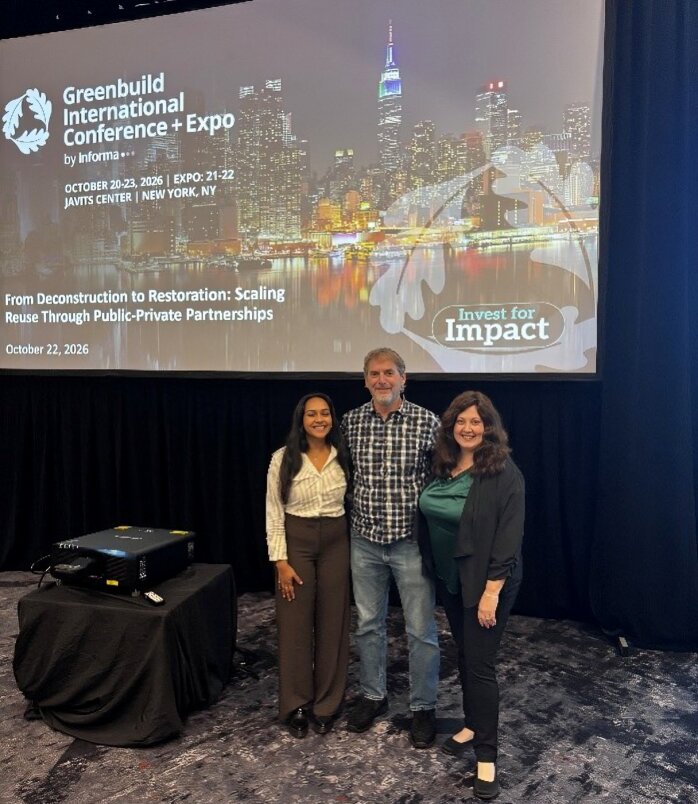
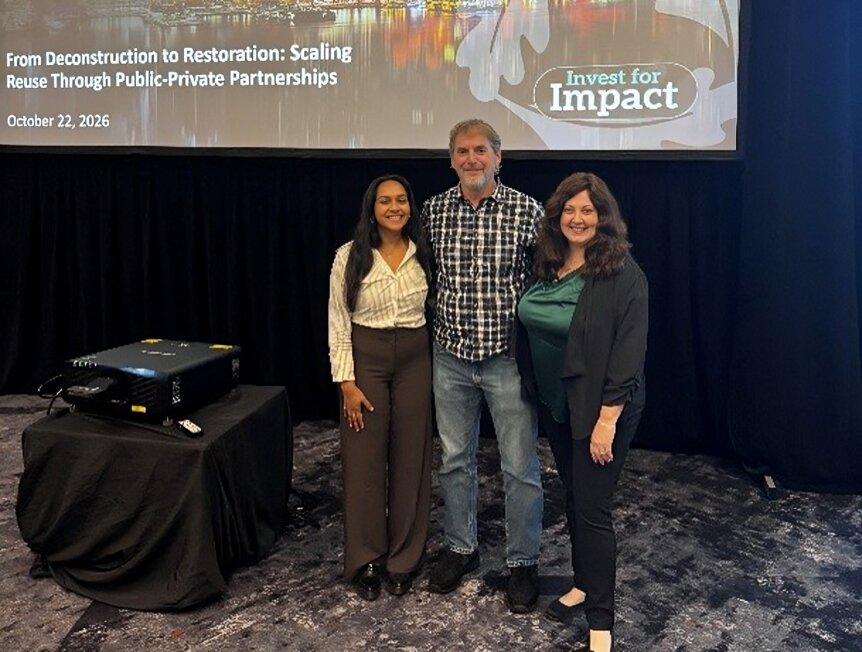
On October 22, 2026, I attended my first Greenbuild International Conference and Expo at the Javits Center in New York, and among the many sessions on the program, one held particular interest for me. Titled “From Deconstruction to Restoration: Scaling Reuse Through Public-Private Partnerships,” it featured Dave Bennink, founder of the Reuse Innovation Center and one of the most respected practitioners in the building deconstruction field, alongside Kristi Chaudhuri, Program Manager for Shell Recycling at the Billion Oyster Project.
Over my five years with The Green Mission Inc. (TGMI) and Green Mission ESG Solutions, Dave’s name has come up repeatedly in conversations with contractors, nonprofit reuse organizations, and clients who are weighing deconstruction as an alternative to demolition. Because our firm prepares qualified appraisals of salvaged building materials donated to charitable organizations, our work depends directly on the industry that he has spent more than three decades helping to build. Hearing him present in person offered a valuable opportunity to understand how one of the field’s leading voices views its progress, its economics, and its future.
Dave Bennink and RE-USE Consulting
Dave Bennink’s career in reuse began with an internship during his studies at Western Washington University, which introduced him to building deconstruction and materials diversion and set the direction for the decades that followed (Western Washington University Foundation). In 1993 he opened his first reuse store, which grew into one of the largest operations of its kind in North America, with more than 50 employees, eight trucks, and 55,000 square feet of retail, repair, remanufacturing, and recycling space (Ulster County RIC Final Report).
He now owns RE-USE Consulting in Bellingham, Washington, and directs the Building Deconstruction Institute. The firm approaches any building scheduled for alteration or removal as a resource to be harvested rather than a liability to be sent to a landfill, a philosophy reflected in its stated mission of building up an industry that takes down buildings (RE-USE Consulting). According to the firm, Dave has salvaged or deconstructed more than 5,000 projects across North America over the course of his career.
The breadth of that experience is considerable. A 2023 feasibility study prepared for Ulster County, New York, reports that RE-USE Consulting has worked in 44 states, five Canadian provinces, the District of Columbia, the U.S. Virgin Islands, and 12 countries, has helped divert more than 100 million pounds of material from landfills, and has assisted more than 200 reuse operations in starting or adapting their businesses (Ulster County RIC Final Report). He was named National Building Deconstructor of the Year in 2009 (Connecticut DEEP meeting notes), and in recent years he has turned his attention to New York, where he has worked to organize reuse practitioners through the NYC Circular Construction Network (AIA New York).
What distinguishes Dave’s perspective is his insistence that deconstruction succeeds on its own economic merits. In a workshop in the U.S. Virgin Islands, he described his central objective as creating businesses in which people can earn a living while protecting the environment (St. Croix Source), and that emphasis on financial sustainability informed nearly every portion of his presentation in New York.
The Scale of Construction and Demolition Waste
Dave opened by observing that construction and demolition (C&D) debris accounts for more than twice the quantity of municipal solid waste generated in the United States, a point supported by federal data. The U.S. Environmental Protection Agency estimates that approximately 600 million tons of C&D debris were generated in 2018, compared with approximately 292 million tons of municipal solid waste. The C&D estimate includes materials from buildings, roads, bridges, and other structures. Demolition activities accounted for more than 90 percent of the total, while approximately 144 million tons were directed to landfills. In New York City, the New York City Economic Development Corporation reports that C&D debris represents approximately 40 percent of the city’s total waste generation.
A subsequent slide, titled “The Cycle of Waste is Accelerating,” illustrated four related trends. The number of buildings continues to rise, while the quality of building materials, the ability to reuse and recycle those materials, and the age at which buildings reach the end of their useful lives are all declining. Considered together, these trends describe a building stock that is growing in size while being constructed from lower-grade and more composite materials that are more difficult to recover, and that is being replaced sooner than in previous generations. Older structures, by contrast, were often framed with dense, durable lumber that can be milled and reused for many more decades, which helps explain why they remain the most valuable sources of reclaimed material.
Dave also presented an aerial photograph of Lower Manhattan and Governors Island accompanied by the observation that there is nothing circular about a semi-circle. I understood this as a critique of how diversion is commonly measured. The EPA notes that aggregate is the primary next use for diverted C&D material (EPA), which means that a substantial portion of what is reported as diverted is crushed into fill rather than returned to use at its highest value. Recycling of this kind completes only part of the material loop, and Dave’s broader argument was that reuse is what allows the loop to close.
TRUE Certification, LEED v5, and the Session Objectives
The session’s learning objectives were organized around two rating systems associated with the U.S. Green Building Council: LEED v5 and TRUE. The presenters set out to demonstrate how circular strategies in design, material selection, construction, and deconstruction support the Materials and Resources credits in LEED v5, to examine public-private partnership models that make those strategies achievable, and to show how quantifying waste diversion, material reuse, and lifecycle impacts can strengthen the business case for circular investment.
TRUE, an acronym for Total Resource Use and Efficiency, is a zero-waste certification program administered by Green Business Certification Inc. (GBCI). The program establishes performance and documentation requirements intended to help organizations reduce waste generation and increase material recovery. Under the published TRUE requirements, projects must demonstrate an average diversion rate of at least 90 percent for eligible nonhazardous solid waste over a qualifying 12-month performance period, excluding disposal through landfilling, incineration, and waste-to-energy. The certification framework also emphasizes documented waste-management policies, material tracking, and ongoing performance accountability. TRUE has expanded its application to construction-related activities, reflecting growing recognition that waste prevention and material recovery must be addressed throughout the built environment. (Facilities Dive).
The slide describing the certification process outlined six steps, beginning with project registration and continuing through preparation and submission of the application, response to reviewer feedback, and acceptance of the certification results, followed by the ongoing submission of a case study and annual diversion data. From an accounting perspective, the final step is especially significant, because it establishes TRUE as a continuing reporting obligation rather than a one-time designation, and it depends on reliable, well-documented records of the weight and destination of every material stream.
LEED v5 reinforces the value of reuse through its revised construction and demolition waste management requirements. Under the Construction and Demolition Waste Diversion credit, salvaged materials directed toward reuse receive credit at twice the diversion rate assigned to other diverted materials. The rating system also emphasizes source separation and establishes minimum requirements for materials salvaged for reuse or separated for recycling. To address concerns regarding the reliability of commingled recycling data, LEED v5 generally limits the recognized diversion rate of commingled recycling facilities to 35 percent unless a higher rate is supported by third-party verification. These provisions create stronger incentives for recovering materials for direct reuse rather than relying primarily on mixed construction debris recycling. A door carefully removed and directed toward reuse can therefore contribute more favorably toward certification than material processed through conventional mixed-waste recycling, reinforcing the practices Dave has advocated throughout his career.
The Portland Model of Public-Private Partnership
The centerpiece of Dave’s discussion of public-private partnerships was Portland, Oregon. His slide credited the collaboration between the City of Portland and RE-USE Consulting with supporting the growth of 20 deconstruction businesses, creating hundreds of jobs over time, earning broad public support, increasing the availability of affordable materials, improving health and safety outcomes, and encouraging other communities to adopt similar programs.
In 2016, the Portland City Council unanimously adopted an ordinance requiring that houses and duplexes built in 1916 or earlier, as well as those designated as historic resources, be deconstructed rather than mechanically demolished, which made Portland the first city in the United States to establish such a requirement (City of Portland). At that time, fewer than 10 percent of the approximately 300 single-family homes removed each year were deconstructed, and the city projected that the ordinance would divert roughly 8 million pounds of material for reuse annually (Association of Oregon Recyclers). The ordinance was subsequently expanded to include houses and duplexes built in 1940 or earlier, with the expanded requirement taking effect on January 20, 2020. Portland’s program continues to apply to designated historic resources meeting the ordinance’s criteria, regardless of construction date. (Green Building Advisor).
Several features of the ordinance contribute to its effectiveness. Covered projects must be performed by a city-certified deconstruction contractor without the use of heavy machinery for structural removal, and the contractor must submit receipts documenting the donation, sale, recycling, or disposal of all materials (Green Building Advisor). Ten years after its adoption, the city reports that 765 buildings have been deconstructed, including 673 houses and duplexes, with more than 4.8 million pounds of lumber recovered for reuse. A typical Portland home yields approximately four tons of reusable material, much of it old-growth Douglas fir, and the region is now served by 14 certified deconstruction contractors and more than 10 salvage retailers, while the city has begun piloting the deconstruction of larger commercial buildings (Axios Portland).
Dave’s RE-USE Consulting helped train the contractors who carried out Portland’s ordinance (Massachusetts DEP presentation). This point is important because policy alone does not account for Portland’s results, and other cities that have encouraged deconstruction have encountered difficulty when contractors were unable to operate profitably or to find trained workers (Building Design + Construction). The Ulster County feasibility study, prepared in partnership with RE-USE Consulting, recommends that a deconstruction ordinance take effect only after a trained workforce and supporting infrastructure are in place, and that the contractors responsible for bidding and managing projects be trained before or alongside their crews (Ulster County RIC Final Report). Portland’s experience suggests that the combination of clear policy and deliberate workforce development is what allows a deconstruction market to mature.
The Reuse Innovation Center Model
Having described the role of public policy, Dave turned to the private enterprise model he has developed to support it, known as the Reuse Innovation Center. His slide associated the model with five areas of public benefit, namely affordable housing, environmental protection, workforce development, historic preservation, and health and safety, each of which a well-managed reuse business can advance in the ordinary course of its operations.
The model addresses a structural challenge facing the reuse industry, which consists largely of small businesses and nonprofit organizations that contend with high operating costs, inconsistent supply and demand, and limited economies of scale. A Reuse Innovation Center brings several of these enterprises together in a single facility that includes intake areas for pricing and inventorying materials, workshops for producing value-added goods, showrooms, warehouses, lumberyards, and classrooms and repair spaces for job training (RE-USE Consulting).
The first such center opened in Bellingham in 2018. According to the Ulster County study, it began operations without business loans or outside funding and reached break-even in its first month, operating from a 20,000-square-foot property that its partners initially rented and later purchased. The participating businesses share employees, equipment, inventory, and marketing expenses while each maintains its own supply chain and business model, and the center gives preference to minority- and women-owned enterprises wherever possible (Ulster County RIC Final Report). Two statements from Dave’s slides captured the philosophy behind the model, the first asserting that the goal is not to add to the circular economy but to multiply it, and the second that affordability is the gateway to sustainability. The latter point deserves particular attention, since reclaimed materials are most likely to gain market share when they are both less expensive and more accessible than new materials, rather than simply more environmentally responsible.
The model is now being tested in New York. Dave’s slides referenced a New York City working group he helped to establish and NYCEDC’s “Ideas for Impact” solicitation, through which the Brooklyn firm Our Temenos was selected to advance a reuse hub. On August 25, 2026, NYCEDC announced a year-long pilot of a Circular Construction Hub at MADE Bush Terminal in Sunset Park, to be operated by Our Temenos, a certified minority- and women-owned ecological landscaping firm. The hub will recover, sort, store, and redistribute construction materials while generating data on the feasibility of reuse-based supply chains in New York City, and it represents the first award made under the Ideas for Impact program (NYCEDC).
The pilot builds on NYCEDC’s 2024 Clean and Circular: Design & Construction Guidelines, which encourage deconstruction, material reuse, and the use of lower-carbon materials on the agency’s capital projects. At the state level, Assemblymember Anna Kelles has introduced legislation, A8637, that would assist municipalities in adopting deconstruction ordinances, support a network of local material hubs, and establish a statewide contractor certification program (NYCEDC). Taken together, these initiatives reflect the same combination of policy, infrastructure, and workforce training that proved effective in Portland, now applied in the largest construction market in the country.
Implications for Valuation and ESG Reporting
Reflecting on the session, I was struck by how much of the reuse industry’s future depends on the quality of its measurement and documentation. Each of the programs Dave described ultimately relies on the ability to establish, credibly and in writing, what a recovered material is, how much of it exists, where it was directed, and what it was worth.
This is evident in the economics of deconstruction itself. During a public session for the Ulster County study, Dave explained that deconstruction contractors can generate revenue through both the removal of structures and the subsequent sale of recovered materials, while potentially reducing landfill disposal expenses and obtaining additional revenue from recyclable metals. The same study identifies another potential economic benefit associated with charitable donations of recovered building materials to qualifying nonprofit organizations. Under Internal Revenue Code Section 170, taxpayers who make eligible donations of building materials to qualified charitable organizations may qualify for a charitable contribution deduction, subject to applicable ownership, property classification, substantiation, and deduction limitations. Generally, when the claimed deduction exceeds $5,000 for an item or group of similar items, the donor must obtain a qualified appraisal from a qualified appraiser and satisfy the applicable Form 8283 reporting requirements, subject to statutory exceptions. The existence of an appraisal does not independently establish deductibility, and the allowable deduction may differ from the property’s appraised fair market value. This is where TGMI’s valuation work becomes particularly relevant. By documenting and supporting the fair market value of eligible donated materials, qualified appraisals provide an important component of the substantiation process and can help property owners evaluate the financial implications of deconstruction alongside removal costs, resale opportunities, and avoided disposal expenses.
The same principles apply to sustainability reporting. Portland requires receipts for every material stream, TRUE requires twelve months of diversion data and annual resubmission, and LEED v5 distinguishes among salvaged, source-separated, and commingled materials in calculating credit. Each of these frameworks raises questions that are familiar to any accountant, including whether reported quantities are adequately supported, whether material destinations are properly documented, and whether assigned values are reasonable. At Green Mission ESG Solutions, our work in corporate decommissioning and ESG reporting addresses precisely these questions, and the session reinforced my view that the circular economy requires rigorous financial and operational accounting as much as it requires skilled deconstruction crews.
As I complete my graduate studies in accounting, I find this intersection especially meaningful. Discussions of the circular economy are frequently framed in terms of tonnage and carbon reductions, yet the initiatives that achieve lasting scale are generally those that can also demonstrate a sound financial return supported by reliable documentation. The experiences in Portland and Bellingham demonstrate the potential for economically sustainable reuse operations, while Brooklyn’s emerging Circular Construction Hub provides an opportunity to evaluate how similar approaches can be adapted to a substantially larger urban construction market.
Conclusion
My first Greenbuild conference offered a great deal to consider, and Dave Bennink’s presentation was among its most valuable sessions. Over more than three decades, he has shown that buildings at the end of their useful lives hold significant recoverable value, that the enterprises built to recover that value can create durable businesses and meaningful employment, and that municipalities can accelerate this progress by pairing thoughtful policy with sustained investment in training. Hearing him present these ideas in New York, as the city begins to develop the reuse infrastructure he has long advocated, made the session especially timely.
The experiences of Portland and Bellingham suggest that the question facing the industry is no longer whether reuse can work, but how quickly its proven models can be replicated and expanded. I believe the valuation and reporting services that TGMI and Green Mission ESG Solutions provide have an important part to play in that expansion, and I am grateful for the opportunity to have learned from one of the individuals who has done the most to shape the field.
About the Author

Caroline J. Marschall is the Chief Operating Officer of The Green Mission Inc. (TGMI), where she oversees valuation research, appraisal production, and operational initiatives supporting the recovery and reuse of building materials. In her fourth year with the company, Caroline works at the intersection of deconstruction, financial valuation, sustainability, and the circular economy, helping advance economically viable alternatives to traditional demolition.
A graduate of the University of Virginia, Caroline is completing her Master of Science in Accounting at William & Mary. Her professional and academic interests include environmental economics, financial policy, sustainable business practices, and the role of accounting and valuation in supporting resource conservation and secondary markets.
Through her work with TGMI and Green Mission ESG Solutions, Caroline is particularly interested in how financial analysis, material valuation, and transparent reporting can strengthen the business case for deconstruction, adaptive reuse, and circular construction. Outside of her professional pursuits, she enjoys international travel and practicing Brazilian Jiu-Jitsu.
Sources
- RE-USE Consulting: Who We Are
- RE-USE Consulting: Re-Use Innovation Center
- Ulster County Reuse Innovation Center Strategic Plan and Feasibility Study, Sustainable Hudson Valley and ReUse Consulting (2023)
- Western Washington University Foundation: Building a Circular Economy in the Building Sector
- Croix Source: Deconstruction workshops with Dave Bennink
- AIA New York: Beyond Recycling, Advancing a Reuse-Driven Future (2025)
- Connecticut DEEP Materials Reuse Network meeting notes (2009)
- Massachusetts DEP: Building Deconstruction Institute presentation
- S. EPA: Construction and Demolition Debris, Material-Specific Data
- S. EPA: Sustainable Management of Construction and Demolition Materials
- City of Portland: Council adopts deconstruction ordinance (2016)
- Association of Oregon Recyclers: Portland deconstruction ordinance
- Green Building Advisor: Portland’s deconstruction program
- Axios Portland: Portland marks a decade of home deconstruction (October 19, 2026)
- Building Design + Construction: Cities promote deconstruction with mixed results
- NYCEDC: Circular Construction Hub pilot at MADE Bush Terminal (August 25, 2026)
- Facilities Dive: Updated TRUE zero waste standard
- Waste Today: GBCI introduces TRUE Zero Waste program
- Bluebeam: The TRUE certification initiative in construction
- Canada Green Building Council: LEED v5 and materials management
- FacilitiesNet: Revamped LEED v5 credits promote responsible materials use
- Session slides, “From Deconstruction to Restoration: Scaling Reuse Through Public-Private Partnerships,” Greenbuild International Conference + Expo, Javits Center, New York, October 22, 2026