

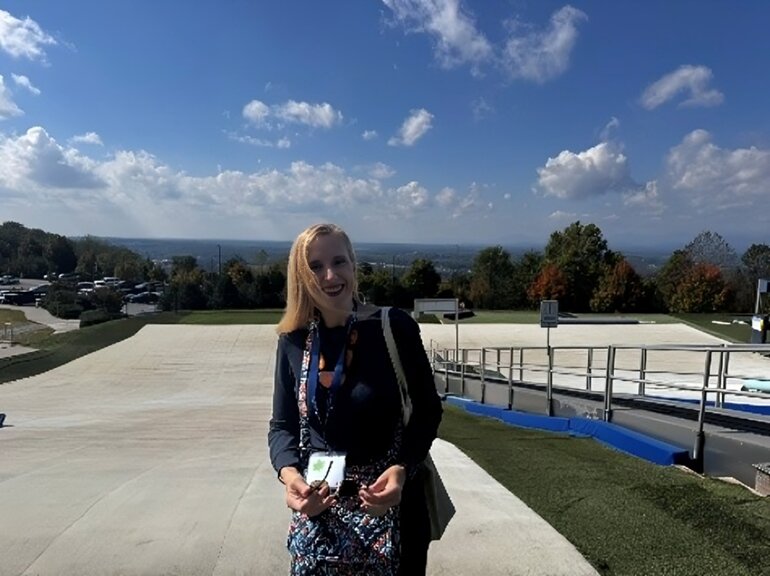
Jessica Irving Marschall, CPA, ISA AM, President & CEO The Green Mission Inc., GM-ESG, MAS LLC, and Probity Appraisal Group
Lynchburg’s downtown revival did not happen through a single grand gesture, rather it happened through a sequence of projects, each one making the next more viable: a historic hotel brought back from four decades of obscurity, a nineteenth-century warehouse turned into a nationally recognized children’s museum, and a new riverfront amphitheater that gives residents and visitors a reason to stay downtown after dark. Together they demonstrate how preservation, adaptive reuse and thoughtful new construction can reinforce one another, and they offer a practical model for the Fredericksburg region and for the kind of sustainable building work that GM-ESG and The Green Mission Inc. hope to help more cities undertake.
The Virginian: A Landmark Recovered
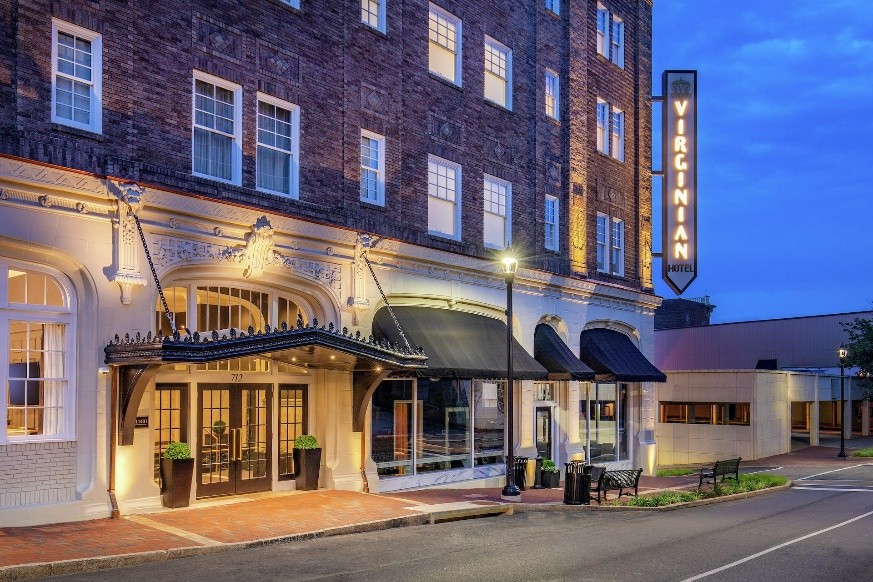
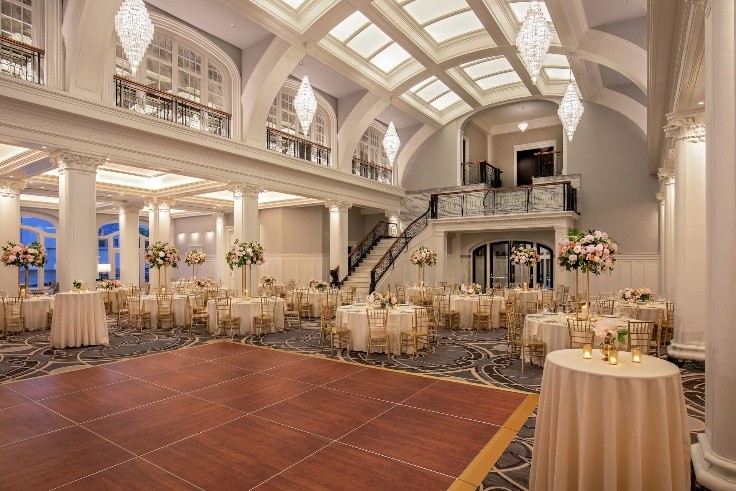
The Virginian opened in 1913 at the corner of Eighth and Church Streets as Lynchburg’s premier downtown hotel. Designed by architect Verus T. Ritter in the Beaux-Arts style, the original building featured arched first-floor windows, a lobby with 30-foot barrel-vaulted ceilings and curved skylights, and a grand marble staircase with wrought iron railings. For half a century it was where Lynchburg celebrated weddings, anniversaries and company dinners, and it hosted guests including Eleanor Roosevelt in 1940 and Ronald Reagan in 1957.
The Depression and the post-war shift in retail took a steady toll. The hotel struggled through the 1960s and was sold in 1968. In 1972 the building became the first dormitory for Lynchburg Baptist College, now Liberty University, and in 1983 its upper floors were converted to subsidized housing while the elegant first-floor spaces were enclosed and used for storage. For roughly forty years, the city’s grandest public rooms were effectively hidden from view.
That concealment turned out to be an act of accidental preservation. When developers George Stanley and Blair Godsey began evaluating the building in the mid-2010s, they found much of the original marble, ornamental plaster, millwork and ironwork still intact. In what was their first hotel project, they assembled a team of designers, trade artisans and construction managers and undertook a four-year restoration that reopened the hotel in May 2018 as The Virginian Lynchburg, Curio Collection by Hilton.
Hilton Curio Collection
How the Numbers Worked
As a CPA, I find the financing of The Virginian as instructive as its architecture. The project, reported by the Lynchburg Economic Development Authority at approximately $25 million and by Lynchburg Tourism at roughly $30 million, was assembled from several layers:
- Federal and state historic rehabilitation tax credits, administered through the National Park Service and the Virginia Department of Historic Resources, which required the work to meet rigorous preservation standards.
- A City of Lynchburg performance agreement under which the hotel pledged at least $100,000 per year to the city.
- Gap financing that included a $2 million loan from the Economic Development Authority and a $3 million private bank loan arranged through the EDA, both repaid from net new taxes generated by the hotel’s operation as a full-service property with three restaurants.
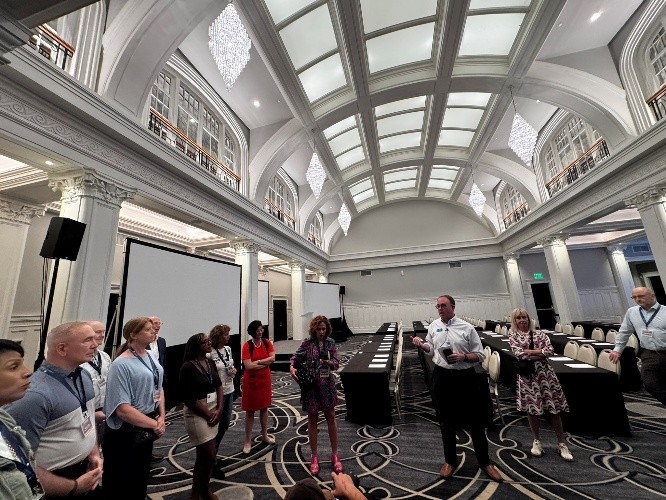
The returns have been measurable. The Economic Development Authority credits the project with 80 new full-time jobs, nearly 300 total jobs across construction, hotel services and food service, and approximately $59 million in economic impact. The hotel offers 115 guest rooms and suites, Lynchburg’s first rooftop restaurant, and a restored ballroom with contemporary event space accommodating up to 440 guests across more than 8,000 square feet. It has earned Hilton’s 2021 Connie Award, AAA’s four-diamond rating, and recognition from Historic Hotels of America, and it has brought statewide conferences to a city that previously lacked a venue of this caliber.
The lesson for our region is that historic tax credits, local performance agreements and tax-increment-style repayment can make a project pencil out when conventional financing alone will not. Just as importantly, preserving the original marble, plaster and ironwork was not merely a design choice. It retained embodied carbon and irreplaceable craftsmanship that no new building could replicate at any price.
More from our team on Historic Tax Credits (HTC):
Amazement Square: Adaptive Reuse as Community Anchor
Our welcome dinner was held inside Amazement Square, a hands-on children’s museum that opened in 2001 within a historic 1860s building on the riverfront. Its founding director, Mort Sajadian, has led the museum and helped advance downtown Lynchburg’s riverfront revitalization since its opening, drawing on more than forty years of leadership in museums, education and the arts and service on the National Museum and Library Services Board. The museum’s four-story Amazement Tower and hands-on exhibits draw families and school groups downtown, and in 2015 the Institute of Museum and Library Services recognized Amazement Square with the National Medal for Museum and Library Service.
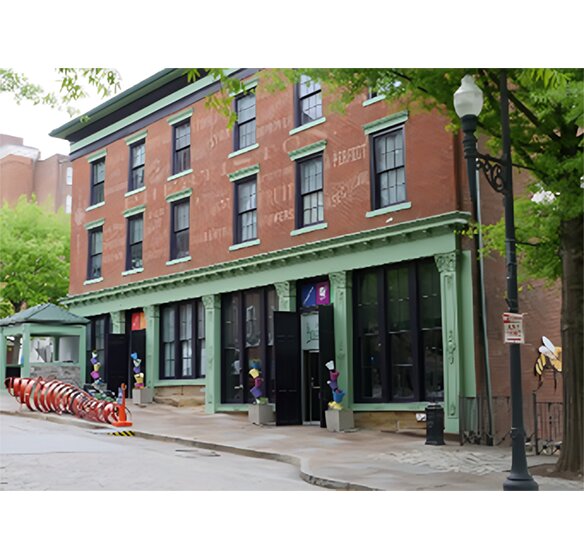
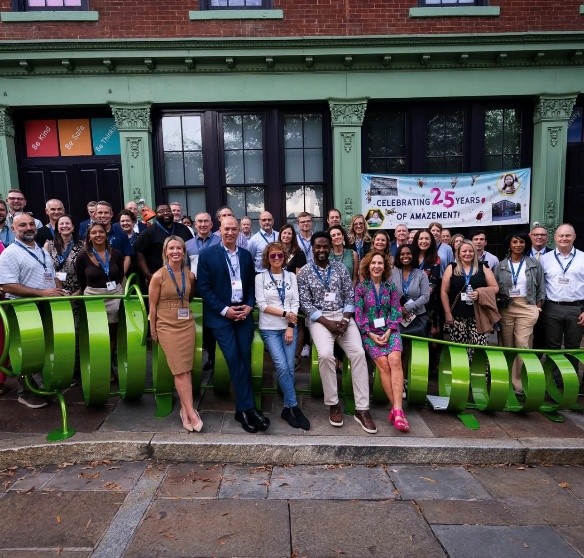
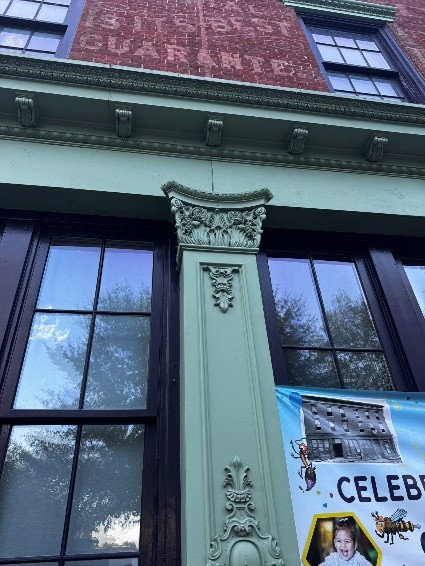
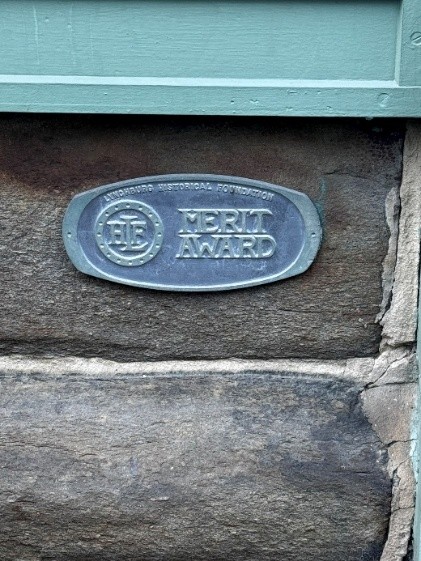
The museum’s Education Center expansion is a textbook example of adaptive reuse. When the 12,000-square-foot metal storage building directly behind the museum was about to be vacated, the museum engaged Lynchburg-based Architectural Partners to rehabilitate what the firm itself described as a nondescript structure. The design honors the railroad heritage of that part of the city, with stonework and heavy timber trestle-style construction on the exterior and interiors modeled on Pullman cars and classic railroad stations. The program includes administrative offices, five exhibition and learning spaces that can be combined or separated, two classrooms, a kitchen and public restrooms. The first phase, completed in 2017, connected the annex to the existing museum and delivered a grand exhibit hall, a shop and several classroom spaces. The capital campaign behind it targeted $6.8 million, including an endowment, and was anchored in 2015 by a $1 million anonymous gift.
Repurposing an unremarkable metal building into a destination is exactly the type of project that rarely gets headlines but that every community can replicate. It avoided demolition waste, reused an existing structural shell, and placed a new educational asset where it reinforces the riverfront rather than sprawling to the edge of town.
More from our team on adaptive reuse:
The Hidden Balance Sheet: Unlocking the Financial Value of Adaptive Reuse
Past Meets Purpose: How Cincinnati Preserves History While Building a Sustainable Future
The Riverfront Amphitheater and Jamerson-Lewis Construction Inc.
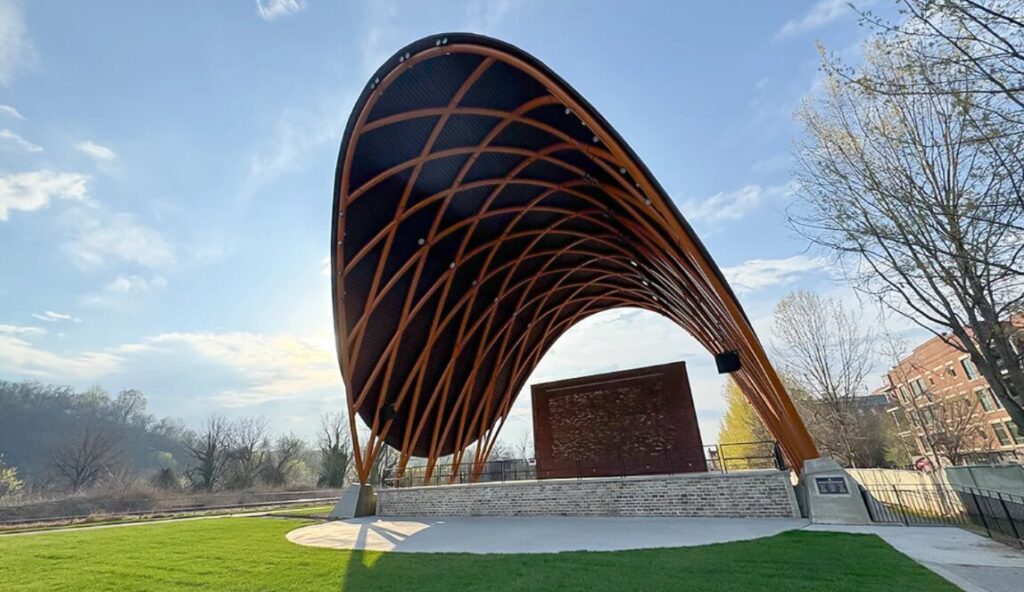
On Thursday evening, our group gathered at The Water Dog, a restaurant and gathering place overlooking the river, where owner Dave Henderson described how private investment has helped anchor quality of place downtown. We then heard from William Cook, President of Jamerson-Lewis Construction, on the vision behind the new Riverfront Amphitheater, what it took to make it happen, and the results the community is now enjoying, before touring the venue itself.
The amphitheater is the centerpiece of a broader Riverfront Park improvement plan that city leaders had discussed since 2000 and that became a key initiative of Lynchburg’s Downtown 2040 Plan. City Council approved $4 million in its 2023 budget to advance the design, city staff sought an additional $3 million from budget surplus, and local reporting has placed the amphitheater at roughly $8 million. Construction began in March 2024 alongside a new Kiwanis playground, public restrooms, lighting and fencing, and crews raised the first of the structure’s steel hoops in April 2025. Notably, the venue was built on a floodplain, which required city staff and contractors to plan carefully for a site that the James River periodically reclaims.
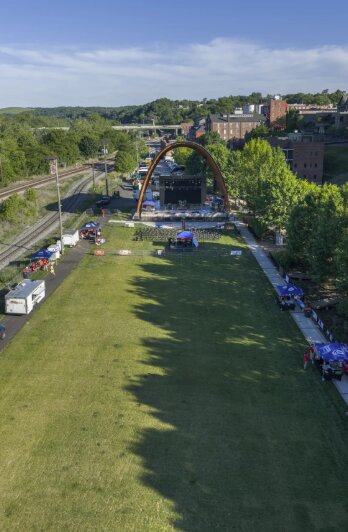
The result is a professional-grade outdoor venue with capacity for roughly 5,000 guests, operated through a partnership with Mason Lane Entertainment, whose managing partner has said the amphitheater employs more than 100 people for every show. It opened in April 2026 with a free community soft-opening concert presented by Jamerson-Lewis Construction, followed in May by its first national touring act. Mr. Henderson captured the civic significance well when he described the project as a statement about “the type of city that Lynchburg wants to be.”
Jamerson-Lewis Construction: Nearly a Century of Building Central Virginia
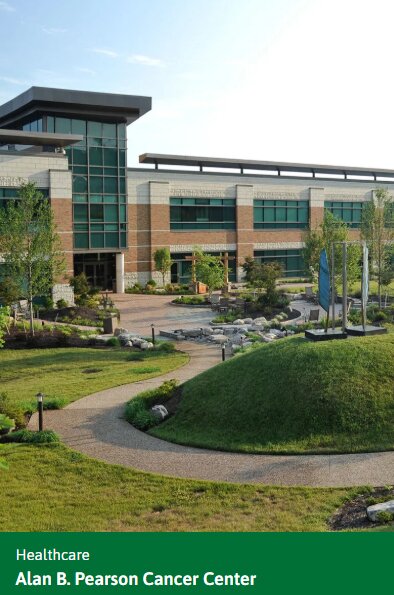
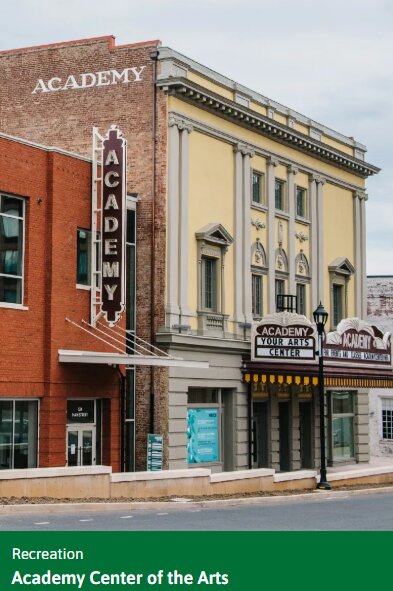
Jamerson-Lewis Construction traces its roots to two Lynchburg firms: C. L. Lewis & Company, founded in 1929 by Charles Langhorne Lewis on the eve of the Great Depression, and J. E. Jamerson & Sons, founded in 1946. C. L. Lewis built the Lynchburg City Armory, and by the 1950s it was serving clients such as the Norfolk and Western and Chesapeake and Ohio railroads, the U.S. Navy and Craddock-Terry Shoe Company. Today the combined firm employs between 100 and 249 people and delivers commercial, institutional and industrial projects across the region using building information modeling, cloud-based estimating and scheduling, and web-based project management. It has completed work for the University of Virginia, opened a permanent office in Charlottesville, and built the Quonset-hut pavilion addition at the National D-Day Memorial in Bedford.
One Jamerson-Lewis project speaks directly to the values we promote at The Green Mission Inc. At the Eugene B. Casey Education and Events Center at Patrick Henry’s Red Hill in Brookneal, the firm built a 5,100-square-foot timber-framed facility whose columns and beams were made from trees harvested on the property itself. Using site-sourced material in a heritage setting is precisely the kind of circular thinking that reduces transportation impacts, preserves a sense of place, and tells a story that visitors remember.
William Cook leads the firm’s strategic direction, estimating, preconstruction and business development. A Virginia Tech graduate, he spoke about the collaboration among city staff, designers, the operator and the construction team that a project of this complexity demands. Preconstruction is where sustainability decisions are won or lost, because that is when a team decides what will be saved, what will be salvaged, and what will be sent to a landfill. Leaders who own that phase are exactly the partners our industry needs.
Sharing Resources: How GM-ESG and The Green Mission Inc. Can Help More Cities Build This Way
What struck me throughout Lynchburg was how each successful project combined a long-term vision with a practical capital stack and skilled people who knew how to execute. At GM-ESG and The Green Mission Inc., our work sits at the intersection of those three elements, and we see several ways to share resources with builders like Jamerson-Lewis, developers like those behind The Virginian, nonprofit owners like Amazement Square and Poplar Forest, and municipal leaders in both regions.
Deconstruction before demolition. Every renovation, reuse or redevelopment project generates materials: doors, millwork, flooring, fixtures, cabinetry, lighting, mechanical equipment and architectural elements. The Green Mission Inc. prepares IRS-qualified, USPAP-compliant appraisals of salvageable personal property so that owners who donate those materials to qualified charitable organizations can document fair market value for a noncash charitable contribution. That turns what would have been a disposal cost into a documented contribution that supports reuse organizations and keeps materials in circulation.
Layering incentives thoughtfully. The Virginian shows how historic tax credits, local performance agreements and public gap financing can work together. Where appropriate and properly planned, the charitable value of donated salvage can become another layer in a project’s financial picture. Coordinating these incentives early, during preconstruction, is essential so that donations, credits and preservation requirements reinforce rather than conflict with one another.
Measuring and reporting impact. Through GM-ESG, we help organizations quantify and communicate the environmental, social and governance outcomes of their projects, from tons of material diverted to the community benefit of jobs created and buildings preserved. Cities competing for investment, grants and visitors increasingly need that data, and contractors who can deliver it gain a competitive advantage.
Building the skilled workforce. Poplar Forest relied on lime plasterers, timber framers and finish carpenters working with hand tools. Deconstruction requires similar care. Partnering with community colleges, career and technical education programs and contractors to train workers in careful material recovery creates livable-wage jobs while preserving building components that would otherwise be lost.
Sharing playbooks across regions. The most valuable resource Lynchburg offered our delegation was its willingness to share what worked, what was difficult and what took longer than expected. We would welcome the opportunity to work with Lynchburg’s leaders and with partners in the Fredericksburg region to develop a shared framework for sustainable restoration and reuse that other mid-sized Virginia cities can adopt.
Lynchburg leveraged what it had: a forgotten hotel, a vacant warehouse, a flood-prone riverfront and a deep bench of builders and civic leaders. The Fredericksburg region has comparable assets, and the question before us is whether we will approach them with the same patience, financial creativity and respect for materials. I believe we can, and GM-ESG and The Green Mission Inc. stand ready to help.
Sources
- 2026 Regional InterCity Visit Briefing Book, Fredericksburg Regional Chamber of Commerce
- Restoration & Reconstruction, Thomas Jefferson’s Poplar Forest
- Poplar Forest, Thomas Jefferson and John Hemings, The Washington Post (April 23, 2023)
- Jefferson’s Retirement Masterpiece: Restoring Poplar Forest, The Decorative Arts Trust
- History, The Virginian Hotel
- The Economic Impact of the Virginian Hotel, Lynchburg Economic Development Authority
- The Virginian: A History, Lynchburg Tourism
- Amazement Square Education Center, Architectural Partners
- $1 Million Gift to Amazement Square for Education Center, Downtown Lynchburg Association
- 2015 National Medal for Museum and Library Service, IMLS
- Construction milestone for Lynchburg’s $8M riverfront amphitheater, WSET
- Riverfront Park Amphitheater construction underway, WSLS
- Riverfront Park Amphitheater almost complete, WSLS
- Riverfront Amphitheater project materializing in Lynchburg, WSLS
- Construction has started to make improvements to Riverfront Park, WDBJ
- Lynchburg offers a look into the future of Riverfront Park, WDBJ
- Amphitheater announces official soft opening, News & Advance
- Jamerson-Lewis Construction company profile and projects, The Blue Book
- Patrick Henry Red Hill Education Center, The Blue Book
- Jamerson-Lewis Construction Charlottesville office, citybiz
- Aerofin
- Aerofin Case Studies
- Ampco-Pittsburgh business description, SEC filing
- HVAC Equipment Gets a Break as Section 232 Tariffs Are Revised, Contracting Business
- ADTRAN Holdings Form 10-Q, Q1 2026 (Section 232 restructuring)
- Helen of Troy Form 10-Q (Section 232 history)
- Watsco Form 10-Q, Q1 2026
- 2026 HVAC Price Increases by Brand, Paschal Air, Plumbing & Electric
- Celebrating manufacturing’s expansion and opportunity, Lynchburg Business Magazine
- Lynchburg, VA Area Economic Summary, U.S. Bureau of Labor Statistics