


From Vacant to Vital, Part II: What Developers Leave Behind When Decommissioning and Deconstruction Are Treated as Demolition Expenses Rather Than Strategic Financial Decisions
Jessica Irving Marschall, CPA, ISA AM President and CEO, GM-ESG | The Green Mission Inc. | Probity Appraisal Group | Marschall Accounting Services LLC October 2026

Introduction: From Policy to Pro Forma
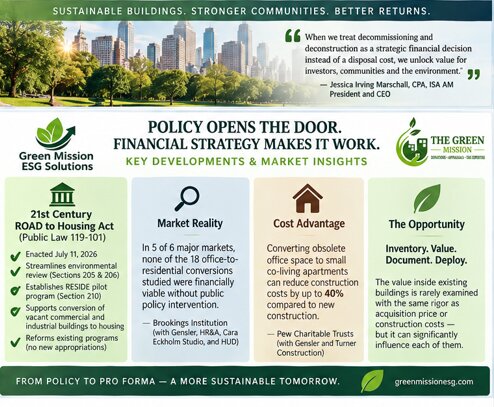
When I wrote From Vacant to Vital in May, the 21st Century ROAD to Housing Act had just cleared the House of Representatives, and the central question was whether Congress would reconcile the House and Senate versions and deliver a meaningful federal framework for adaptive reuse, building conversion, and the redevelopment of vacant commercial and institutional properties. That question has now been answered, and as our team prepares to join thousands of architects, engineers, developers, investors, and sustainability professionals at the Greenbuild International Conference and Expo at the Javits Center in New York from October 20 through October 23, 2026, the more pressing question has shifted from whether policy will support adaptive reuse to whether the individual projects that policy is meant to encourage can actually be made to work financially.
It is fitting that Greenbuild has organized its 2026 program around the theme Invest for Impact, with a particular focus on investment, new project development, and the retrofitting of existing structures, because those are the pivotal conversations in which the economics of decommissioning and deconstruction have been underrepresented for far too long. In my experience as a CPA, a qualified appraiser, and the leader of a practice that has completed IRS-qualified deconstruction appraisals on residential and commercial properties across the country, the value that remains inside an existing building is rarely examined with the same rigor that is applied to acquisition price, construction costs, financing terms, and projected rents, even though it can significantly influence each of those figures.
My first article established the policy and sustainability case for integrated decommissioning and deconstruction. This article addresses the more commercially significant question that I expect will animate many of the conversations on the Greenbuild expo floor: how do developers, building owners, investors, and municipalities make adaptive reuse financially feasible, and what value are they leaving behind when they treat the materials, fixtures, and embodied carbon inside an existing building as a disposal cost rather than as a set of assets to be inventoried, valued, documented, and deployed?
What Has Changed Since May
The 21st Century ROAD to Housing Act became Public Law 119-101 on July 11, 2026, establishing a new federal policy framework intended to address housing supply constraints, modernize regulatory procedures, and encourage the productive reuse of existing properties. Among the provisions most relevant to adaptive reuse are Sections 205 and 206, which address environmental review procedures, and Section 210, which establishes the Revitalizing Empty Structures Into Desirable Environments (RESIDE) pilot program. The RESIDE provisions are particularly significant for owners, developers, and municipalities evaluating the conversion of vacant commercial and industrial properties into residential uses because they contemplate using existing federal housing program infrastructure to facilitate redevelopment. However, the legislation does not establish a universal financial incentive for adaptive reuse, nor does it guarantee that individual conversion projects will receive federal assistance. Its practical impact will depend on implementation, program eligibility, future appropriations, and the ability of state and local governments to translate statutory authority into workable redevelopment opportunities.
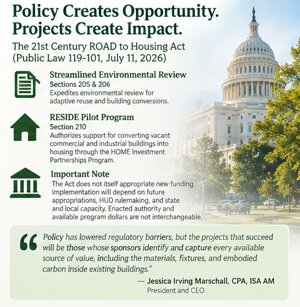
That critical distinction is why the financial structure of each individual project matters so much. If federal policy has lowered regulatory barriers without simultaneously closing the funding gap, then the projects that succeed will be those whose sponsors identify and capture every available source of value, including sources that conventional demolition-oriented budgeting tends to overlook entirely.
The Feasibility Gap That Legislation Alone Cannot Close
The most sobering research on adaptive reuse economics comes from the Brookings Institution, working with Gensler, HR&A Advisors, and Cara Eckholm Studio with support from the U.S. Department of Housing and Urban Development. The researchers evaluated eighteen actual office buildings across six markets—Houston, Los Angeles, Pittsburgh, St. Louis, Stamford, and Winston-Salem—to examine the financial feasibility of converting underutilized commercial properties into housing. Sixteen of the eighteen buildings produced negative net present values under the baseline assumptions, and in five of the six markets, none of the studied conversions was financially viable without public policy intervention. These findings underscore the economic challenges associated with office-to-residential conversion, including acquisition costs, construction requirements, financing conditions, achievable residential rents, and the physical limitations of existing structures. They also demonstrate why adaptive reuse cannot be evaluated solely through conventional development assumptions. When projects already face narrow financial margins, the identification of recoverable building components, avoided procurement expenses, potential tax attributes, and reduced disposal costs becomes an important part of a more complete feasibility analysis.
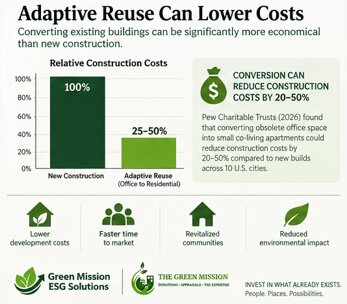
The Pew Charitable Trusts, working with Gensler and Turner Construction Company, examined a different approach to improving conversion economics across ten U.S. cities. Its March 2026 analysis found that converting obsolete office buildings into small co-living apartments could reduce construction costs by approximately 25 to 35 percent per square foot compared with conventional office-to-apartment conversions. The research also estimated that co-living conversions could produce an average of 3.9 times as many affordable homes per dollar of public subsidy as conventional studio apartment conversions under the modeled assumptions. These findings are particularly relevant because they demonstrate how changes in building configuration, unit design, and construction scope can materially influence financial feasibility without necessarily requiring an entirely new development site. The results should not be interpreted as a universal cost reduction for adaptive reuse compared with new construction, however, because the study specifically compared alternative approaches to converting existing office buildings. Pew also identified financial feasibility gaps across the markets examined, reinforcing the need to evaluate financing, regulatory constraints, construction costs, and potential sources of recovered value together rather than treating any single strategy as sufficient to make a project economically viable.
Read together, these studies make a point that I believe deserves far more attention than it typically receives. The feasibility of a conversion is not determined solely by the building’s floor plate, location, and market rents, nor solely by the incentives a city chooses to offer. It is determined by the sum of every cost avoided, every dollar recovered, every credit and deduction properly claimed, and every risk reduced through good documentation. Both cost and carbon avoidance are key metrics we study and upon which report at GM-ESG for our corporate clients. When the margin between a viable project and an abandoned one is measured in a few percentage points of return on cost, the value of the materials already inside the building, together with the tax and reporting consequences of how those materials are handled, can become decisive rather than incidental.
The Hidden Balance Sheet Inside Every Existing Building
Every building slated for conversion carries what I have come to call a hidden balance sheet: a collection of assets, avoided costs, and potential tax attributes that do not appear on the acquisition closing statement or in the construction budget, but that nonetheless exist from the moment the owner takes possession. In a conventional demolition-oriented budget, the interior of a building is represented by a single line item for demolition, hauling, and tipping fees, which implicitly assigns a value of zero, or less than zero, to everything that will be removed. In an integrated decommissioning and deconstruction approach, that same interior is inventoried, assessed for condition, and separated into categories that each carry distinct financial consequences.
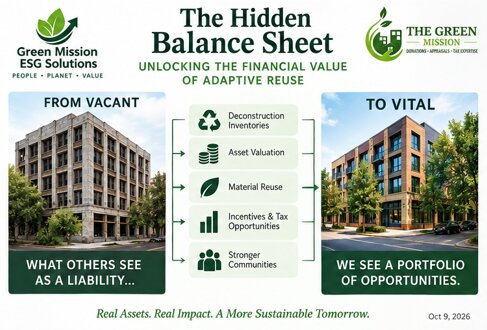
The first category consists of components that can be retained and redeployed within the converted building itself, such as doors, hardware, lighting, millwork, stone, and flooring, which reduce the quantity of new materials that must be purchased and, in historic properties, may be required to remain in place in any event. The second category consists of furniture, fixtures, equipment, and architectural salvage with active secondary-market demand, which can be sold to offset project costs. The third category consists of materials and fixtures that may be donated to qualifying charitable organizations, such as reuse centers and affordable housing builders, where the donor may be eligible for a charitable contribution deduction when the property is properly appraised and substantiated. The final category consists of materials that genuinely have no reuse value and should be recycled or responsibly disposed of, ideally in smaller volumes than a conventional demolition would generate.
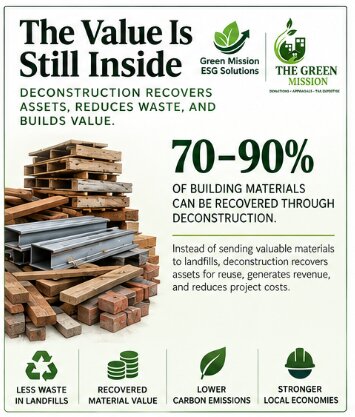
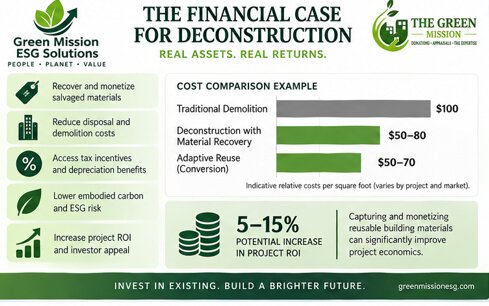
The financial significance of this classification is that it transforms a single demolition and disposal expense into several potential sources of economic value, each of which must be evaluated according to its actual financial characteristics. Materials retained within the project may reduce future procurement expenditures, while components sold into secondary markets may generate proceeds that offset redevelopment costs. Qualifying charitable contributions may produce tax benefits when the applicable ownership, valuation, substantiation, and deduction requirements are satisfied. Selective deconstruction may also reduce hauling and landfill disposal expenses, although these savings must be weighed against the additional labor, handling, transportation, storage, and processing costs associated with material recovery. Importantly, the appraised fair market value of salvaged property should not be confused with the net cash proceeds a developer can reasonably expect to realize from its sale. Fair market value, estimated resale proceeds, avoided replacement costs, and potential tax deductions represent distinct financial measures, and each requires its own assumptions and documentation. When these categories are evaluated separately and incorporated into the development pro forma, the recoverable assets inside an existing building can become measurable components of project feasibility rather than an overlooked consequence of demolition.
The practical lesson is that this hidden balance sheet must be prepared before demolition and conversion scopes are finalized. Once a building has been gutted, the opportunity to inventory, value, and document its contents is gone, and so is the evidence that a taxpayer, an ESG reporting team, or a public funding agency would need to substantiate the outcomes.
The Tax Architecture of a Conversion
For many projects, the most consequential entries on the hidden balance sheet are tax attributes, and they interact with one another in ways that reward early, coordinated planning and penalize after-the-fact reconstruction.
Charitable contributions under IRC Section 170. When an owner donates salvaged building materials, fixtures, equipment, or other qualifying property to an eligible charitable organization, a federal charitable contribution deduction may be available, subject to the applicable statutory requirements and limitations. For noncash charitable contributions exceeding $5,000, taxpayers generally must obtain a qualified appraisal prepared by a qualified appraiser and satisfy the reporting requirements associated with Form 8283. When the claimed deduction for a contribution exceeds $500,000, the qualified appraisal generally must also be attached to the federal income tax return. These substantiation requirements are especially important in deconstruction projects because the property being donated may consist of numerous individual components with different ages, conditions, quantities, and secondary-market characteristics. The allowable deduction is not necessarily equal to the property’s appraised fair market value. It may be limited by the donor’s adjusted tax basis, the character of the property, the applicable holding period, depreciation recapture considerations, and the nature of the recipient organization and its use of the donated property. Developers holding property primarily for sale to customers, for example, may be subject to different deduction limitations than long-term owners disposing of capital assets. Furthermore, the appraisal must address the property actually contributed, and the donor must establish that the charitable transfer satisfies the applicable ownership, delivery, acknowledgment, and substantiation requirements. A properly supported valuation is therefore one essential component of the tax analysis, but it does not independently establish entitlement to the deduction.
The One Big Beautiful Bill Act changes. The One Big Beautiful Bill Act introduced additional limitations affecting charitable contributions beginning with tax years after December 31, 2025, making advance tax modeling increasingly important for property owners contemplating substantial noncash donations. For C corporations, the legislation generally establishes a charitable contribution deduction floor equal to one percent of taxable income, while retaining the existing ten percent limitation, subject to the applicable statutory calculations and carryforward provisions. For individuals who itemize deductions, the legislation generally introduces a floor equal to one-half of one percent of adjusted gross income, meaning that charitable contributions must exceed that threshold before generating an allowable itemized charitable deduction, subject to other applicable limitations. These provisions are particularly consequential for deconstruction donations because the appraised value of recovered materials does not automatically translate into an equivalent reduction in taxable income, and the ultimate tax benefit may vary substantially depending on the donor’s entity classification, taxable income, adjusted gross income, basis, and other charitable contributions. S corporations, partnerships, C corporations, and individual property owners may experience different outcomes because of the interaction between entity-level reporting and taxpayer-level deduction limitations. Consequently, any projected tax benefit from donating recovered materials should be modeled using the taxpayer’s specific circumstances and applicable tax year rather than presented as a fixed percentage of the appraised value.
Historic tax credits. For qualifying certified historic structures, the federal rehabilitation credit under IRC Section 47 generally provides a credit equal to twenty percent of qualified rehabilitation expenditures, claimed ratably over five years, subject to the statutory and regulatory requirements governing eligible buildings, expenditures, ownership, and rehabilitation work. State historic rehabilitation tax credits may provide additional incentives, although eligibility, credit percentages, transferability, and coordination with federal benefits vary by jurisdiction. These incentives can be especially important in adaptive reuse projects involving older commercial, institutional, and residential structures, but they require careful coordination between the redevelopment plan and the preservation requirements applicable to the property. The National Park Service, State Historic Preservation Offices, and the Secretary of the Interior’s Standards for Rehabilitation play important roles in determining whether proposed work is consistent with the historic character of a certified structure. Selective deconstruction may support an eligible rehabilitation when it involves removing inappropriate later additions or nonhistoric materials, but the removal of character-defining architectural features can jeopardize certification and the associated tax benefits. Owners must also distinguish expenditures that qualify for the rehabilitation credit from costs that are excluded, separately capitalized, or otherwise treated under the applicable tax rules. For these reasons, decisions involving salvage, retention, replacement, and material donation should be coordinated with the preservation team and tax advisors before construction documents are finalized, particularly when the project’s financial feasibility depends on historic rehabilitation incentives.
Opportunity Zones. The One Big Beautiful Bill Act made significant changes to the federal Opportunity Zone program, establishing a permanent framework with recurring ten-year designation cycles and new qualified opportunity zone designations scheduled to take effect beginning January 1, 2027. These changes create additional planning considerations for investors, developers, and municipalities seeking to attract long-term capital to economically distressed communities. For projects involving existing commercial or institutional buildings, the Opportunity Zone rules can be particularly relevant because the acquisition and improvement of previously constructed property may implicate the substantial improvement requirements applicable to Qualified Opportunity Zone Business Property. The financial and tax consequences depend on the ownership structure, the timing and amount of qualifying investment, the property’s original use, and the statutory requirements governing eligible property and qualified improvements. Selective deconstruction and adaptive reuse may form part of a broader redevelopment strategy, but the recovery or donation of existing building components does not independently establish compliance with Opportunity Zone requirements. Rather, these activities should be integrated into the project’s acquisition, rehabilitation, capitalization, and tax planning so that the developer can evaluate their economic consequences alongside any Opportunity Zone benefits. Readers interested in these provisions may review our related MAS LLC articles,
Opportunity Zones 2.0: A New Era of Community Investment Under the OBBBA and Understanding Opportunity Zone Tax Incentives and Qualified Opportunity Funds.
Opportunity Zones 2.0: The Complete Guide to Enhanced Benefits Under the One Big Beautiful Bill Act
Understanding Opportunity Zone Tax Incentives and Qualified Opportunity Funds
The common thread across each of these regimes is that the tax outcome depends on facts that must be established before the building is altered: what was present, what condition it was in, what it was worth, where it went, and who received it. The availability and amount of any deduction or credit will always depend on the individual taxpayer’s facts and circumstances, and owners should consult their own tax advisors before relying on any of these provisions.
Carbon and Cost Belong in the Same Model
One of the more persistent habits in our industry is the practice of evaluating a project’s financial feasibility in one spreadsheet and its environmental performance in an entirely separate sustainability report, often prepared by a different team after the key decisions have been made. Recent research suggests that this separation obscures the very relationships that investors and lenders most need to understand.
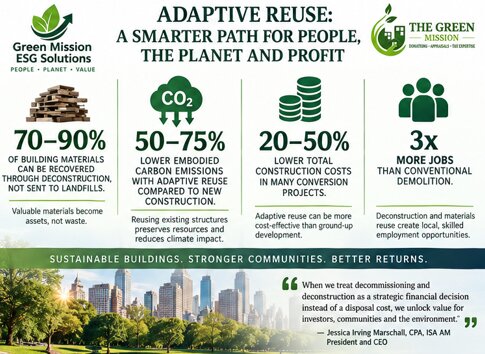
A 2026 study published in Energy and Buildings by researchers at Tampere University provides a particularly useful example of why adaptive reuse should be evaluated through an integrated financial and environmental framework. The researchers examined the conversion of an office building to residential use in the Helsinki metropolitan area, comparing the adaptive reuse scenario with demolition and new construction through life cycle assessment and life cycle costing. Under the study’s assumptions, the adaptive reuse scenario generated approximately 54 percent of the upfront greenhouse gas emissions associated with the new-construction alternative, representing a reduction of approximately 46 percent. Over a fifty-year assessment period, the adaptive reuse scenario produced approximately 81 percent of the greenhouse gas emissions of the new-construction baseline. The financial findings were similarly significant: the adaptive reuse scenario required approximately 48 percent of the initial building costs and 62 percent of the total life cycle costs of the new-construction alternative. These results demonstrate that retaining and adapting existing structures can generate meaningful environmental and financial advantages simultaneously, but they are specific to the building, location, design alternatives, assessment boundaries, and assumptions examined in the research. They should not be interpreted as universal savings percentages applicable to every conversion project. Their broader significance lies in demonstrating how embodied carbon, operating performance, initial capital requirements, and long-term ownership costs can be evaluated within one analytical framework rather than through disconnected sustainability and financial studies.
These findings also highlight the importance of distinguishing upfront embodied carbon reductions from total life cycle environmental performance. Retaining an existing structure can avoid substantial emissions associated with manufacturing, transporting, and installing replacement building materials, but those initial advantages must be evaluated alongside the energy efficiency, operating characteristics, and expected service life of the completed building. Research examining office-to-residential retrofits in the United Kingdom has demonstrated that the relative environmental advantages of retrofit and new construction can change over time when a new building achieves substantially better operational energy performance than the renovated alternative. Consequently, the strongest sustainability case for adaptive reuse is not based simply on preserving an existing structure, but on combining material retention with appropriately designed improvements to building systems, energy performance, and long-term functionality. For investors and lenders, this distinction matters because a project that reduces upfront emissions but creates excessive operating costs or future capital replacement requirements may produce a different financial outcome than one that successfully integrates both embodied and operational performance. The objective should therefore be to evaluate carbon and cost together across a defined project life cycle, using assumptions that are transparent, measurable, and appropriate to the specific property.
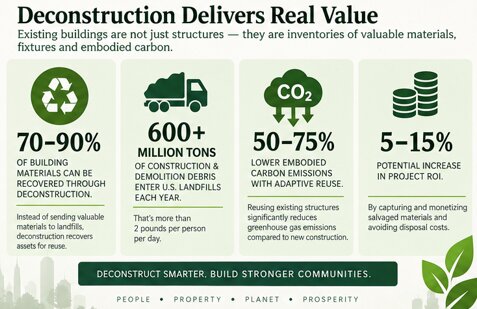
This is also where decommissioning and deconstruction enter the analysis in a way that many models omit. Materials diverted from landfill and redeployed elsewhere avoid both disposal costs and the emissions associated with manufacturing replacements, and when those outcomes are measured, valued, and documented at the time of removal, they can be reported credibly alongside the project’s financial results rather than estimated retrospectively.
Making Recovered Materials Bankable
If recovered materials are to carry real weight in a project’s capital stack, procurement decisions, and investor reporting, they must be documented to a standard that a lender, an auditor, a public agency, or the Internal Revenue Service would accept. This has historically been one of the weakest links in the circular construction market, and a significant 2026 development suggests that the market is beginning to address it.
In April 2026, the Carbon Leadership Forum, working with Eastern Research Group, published Reclaimed and Reused: Recommended LCA Modeling Guidance to Support EPDs for Reused Construction Materials. The report addresses a gap that has quietly disadvantaged salvaged materials for years: North America has had no environmental product declarations for reused construction products and no product category rules to guide their development, which means that reclaimed steel, lumber, and brick could be effectively excluded from low-carbon procurement policies and Buy Clean programs that require an EPD, even when their embodied carbon profile is demonstrably favorable. The guidance provides example life cycle assessment results for reused lumber, steel, and brick and lays the methodological groundwork for independent verification, although, as the authors acknowledge, publishing modeling rules is only the first step toward commercially available reuse EPDs.
For owners and developers, the practical implication is that recovered materials require a coordinated documentation process capable of supporting several distinct financial, tax, operational, and environmental objectives. A comprehensive material inventory establishes the identity, quantity, physical characteristics, and condition of the components present before deconstruction begins. An independent appraisal prepared in accordance with applicable professional standards can establish an appropriate opinion of value for a specified intended use, such as substantiating a noncash charitable contribution, evaluating potential sale proceeds, or supporting a particular financial decision. However, different intended uses may require different definitions of value, valuation premises, reporting requirements, and accounting considerations; an appraisal prepared for federal income tax purposes does not automatically satisfy the requirements applicable to insurance, financial reporting, or another assignment. Chain-of-custody records document the disposition of recovered materials, including their transfer to purchasers, charitable recipients, reuse facilities, or recycling operations. Separately, life cycle assessment and embodied carbon calculations can quantify environmental outcomes using recognized methodologies and clearly identified assumptions. When these records are developed together, owners can create a defensible body of evidence that supports tax substantiation, financial analysis, material recovery reporting, and ESG disclosures without incorrectly treating these different measures as interchangeable. This integrated documentation approach is central to the services provided through GM-ESG, The Green Mission Inc., and Probity Appraisal Group.
When these four records are prepared together, at the time the work is performed, they reinforce one another and give every stakeholder a single, consistent account of what happened to the building. When they are prepared separately or after the fact, they tend to conflict, and conflicting records are exactly what examiners, auditors, and skeptical investors look for. This integrated approach is the foundation of the services we provide through GM-ESG, The Green Mission Inc., and Probity Appraisal Group.
A Practical Sequence for Owners, Developers, and Municipalities
The greatest value is captured when material recovery planning begins during due diligence rather than during demolition, and in our experience the following sequence allows owners to preserve the most options at the least cost.

- Inventory and assess the building during acquisition due diligence. Before the purchase price is finalized or the conversion scope is fixed, a decommissioning team should document the furniture, fixtures, equipment, and building components present, together with their condition, so that their potential value can inform both the offer and the design.
- Classify materials according to their highest financial use. Each category of material should be assigned to retention within the project, sale into secondary markets, charitable donation, or recycling, with the classification informed by the owner’s tax position, any historic preservation requirements, and the needs of the converted building.
- Engage qualified valuation and tax advisors before anything is removed. A USPAP-compliant appraisal prepared by a qualified appraiser, together with tax modeling that reflects the donor’s character, basis, and applicable limitations, ensures that expected benefits are realistic and properly substantiated.
- Write deconstruction into the contract documents. Selective removal, protection, and chain-of-custody requirements should appear in the scope of work and the general contractor’s agreements, rather than being left to the discretion of a demolition subcontractor operating under schedule pressure.
- Measure and document outcomes as the work proceeds. Diversion weights, recipient acknowledgments, photographs, and embodied carbon calculations should be captured contemporaneously, so that tax, ESG, lender, and public funding reports all draw upon a single verified record.
- Integrate the results into the financial model and investor reporting. The financial consequences of deconstruction and material recovery should be incorporated into the project pro forma using clearly differentiated categories of economic value. Avoided procurement expenditures, net material sale proceeds, reduced disposal costs, incremental deconstruction expenses, and potential tax benefits should be calculated separately to prevent double counting and to distinguish realizable cash flows from noncash tax attributes or estimated asset values. Any charitable contribution benefit should reflect the taxpayer’s actual eligibility, adjusted basis, applicable deduction limitations, and substantiation requirements rather than assuming that appraised fair market value produces an equivalent tax savings. Similarly, the environmental benefits of material recovery should be quantified using documented quantities, disposition records, and appropriate carbon assessment methodologies, with any financial value attributed to those outcomes supported by identifiable contractual, regulatory, or market mechanisms. Incorporating these measures into the development budget, financing assumptions, and investor communications allows owners to demonstrate how material recovery affects project costs, risk, tax exposure, and environmental performance. The resulting analysis provides a more credible foundation for capital allocation decisions and enables lenders, equity partners, and public agencies to evaluate the financial and sustainability consequences of adaptive reuse within a consistent reporting framework.
Municipalities have a role to play as well. Local governments administering delegated environmental reviews, RESIDE pilot funds, or their own conversion incentives can encourage this sequence by requesting material inventories and diversion plans as part of project applications, by recognizing documented embodied carbon outcomes in their evaluation criteria, and by connecting conversion projects with local reuse organizations that can receive donated materials and redeploy them in affordable housing and community rehabilitation work.
Looking Ahead to Greenbuild
New York is an especially fitting setting for this conversation. The city’s inventory of aging office buildings, its ambitious building emissions requirements, and its long history of adaptive reuse make it a living laboratory for the questions this article raises, and I have seen firsthand, through our own decommissioning work on Roosevelt Island, how much recoverable value and how many documentation challenges can exist within a single property.
As I walk the Greenbuild expo floor and attend sessions on investment, development, and retrofitting, I will be listening for how owners, lenders, and design teams are accounting for the materials and embodied carbon already present in the buildings they intend to transform. My hope is that the conversation will move beyond the familiar observation that reuse is good for the environment and toward a more rigorous recognition that reuse, when properly inventoried, valued, and documented, is also a source of measurable financial value that can help close the feasibility gaps identified by Brookings, Pew, and others.
The ROAD to Housing Act has given the country a clearer policy framework for converting vacant structures into homes, but policy alone will not determine which of those projects are built. Those outcomes will be shaped by the discipline with which sponsors examine every element of value available to them, including the hidden balance sheet that exists inside every existing building. I welcome the opportunity to continue this discussion with fellow attendees in New York, and I encourage property owners, developers, institutions, and municipalities evaluating redevelopment opportunities to begin material recovery planning early in the project lifecycle, well before the first wall comes down.
Sources
- Greenbuild International Conference + Expo, About Greenbuild (2026, Javits Center, New York)
- GM-ESG, From Vacant to Vital (May 2026)
- Congressional Research Service, The 21st Century ROAD to Housing Act (P.L. 119-101)
- Holland & Knight, 21st Century ROAD to Housing Bill Becomes Law, Seeks to Boost Housing Supply (August 2026)
- LeadingAge, Landmark Housing Bill Becomes Law (July 2026)
- Brookings Institution, A Community Guide to Office-to-Residential Conversion: Part 1, Economics
- Brookings Institution, Understanding Office-to-Residential Conversion: Lessons from Six U.S. Case Studies
- The Pew Charitable Trusts, Converting Obsolete Offices to Small Co-Living Apartments Could Help Ease U.S. Housing Shortage (March 2026)
- Moisio et al., Carbon and Cost Implications of Adaptive Reuse, Energy and Buildings (2026)
- Mok et al., Carbon Viability of Retrofitting Office Buildings to Residential Use, Energy and Buildings
- Carbon Leadership Forum, Reclaimed and Reused: Recommended LCA Modeling Guidance to Support EPDs for Reused Construction Materials (April 2026)
- S. Environmental Protection Agency, Sustainable Management of Construction and Demolition Materials
- Internal Revenue Code Sections 47 (Rehabilitation Credit) and 170 (Charitable Contributions and Gifts)
- Uniform Standards of Professional Appraisal Practice (USPAP), The Appraisal Foundation
About the Author
Jessica Irving Marschall, CPA, ISA AM, serves as President and CEO of GM-ESG, The Green Mission Inc., Marschall Accounting Services LLC, and Probity Appraisal Group. With twenty-six years of experience as a CPA and more than seven years building The Green Mission Inc.’s IRS-qualified deconstruction appraisal practice, she has authored more than 150 published articles on tax, valuation, sustainability, and deconstruction topics and presents nationally on ESG reporting, Opportunity Zones, adaptive reuse, and deconstruction appraisal. She will be attending Greenbuild 2026 in New York and welcomes the opportunity to connect with attendees exploring the financial side of adaptive reuse.
This article is provided for general informational purposes and does not constitute tax, legal, or investment advice. Readers should consult their own advisors regarding their specific facts and circumstances.