

Beyond the Project is a series from The Green Mission Inc. reconnecting with former clients to explore their ongoing endeavors and the lasting impact of their decisions.
Building a Place to Breathe: Sunset Bridge Corporation’s Vision for Bethany Beach
From a thoughtfully personal home to a nonprofit retreat for families navigating end-of-life care, former Green Mission client Terri Sarisky is finding new ways to put compassion and environmental stewardship into practice.
By Amy Bria, Director of Communications
The Green Mission Inc.
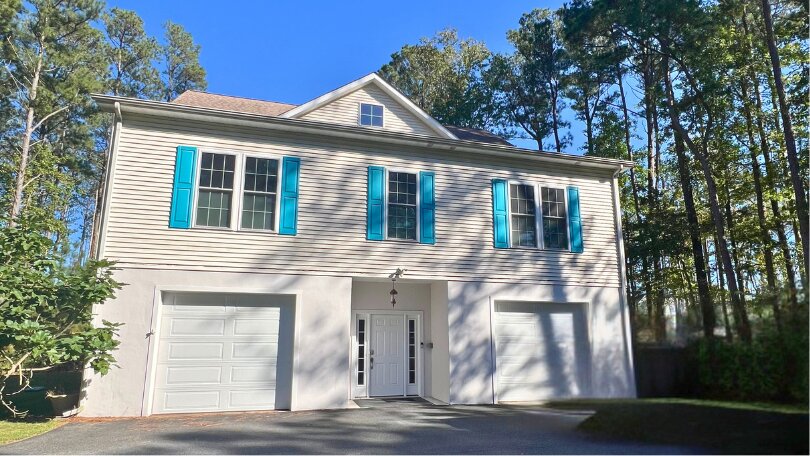
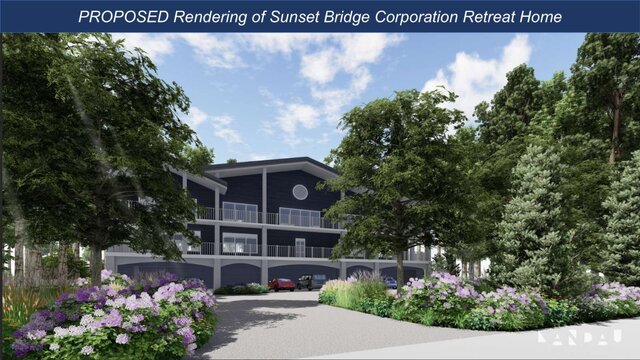
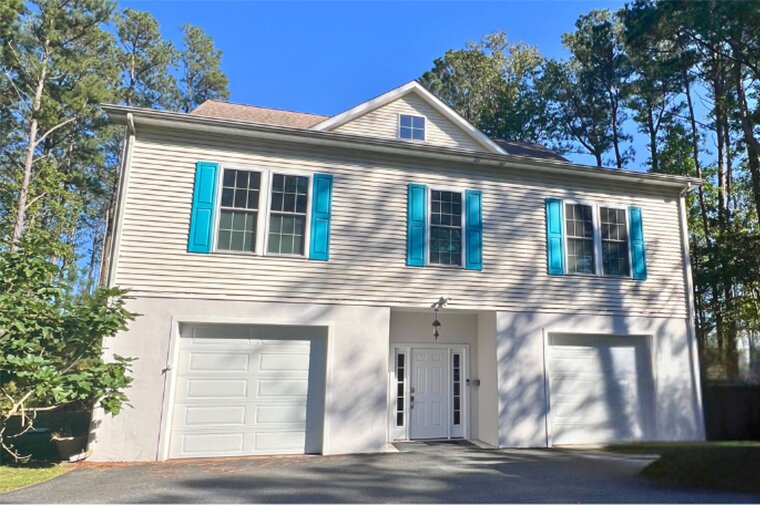
Pictured above: The original structure on the Sunset Bridge Corporation site (left), alongside an architectural rendering of the envisioned respite home (right). Rendering courtesy of Sunset Bridge Corporation.
“Just as ripples spread out when a single pebble is dropped into water, the actions of individuals can have far-reaching effects.” – His Holiness the Dalai Lama
For Terri Sarisky, that pebble was a cup of tea and a moment of fresh air that provided comfort during an extraordinarily difficult time. As a caregiver of a relative with a terminal diagnosis, Sarisky was trying to manage the physical and emotional toll of grief and everyday life all at once. That one gesture from a nurse, allowing Sarisky to breathe, is one she reflects on as she discusses her motivation behind the nonprofit Sunset Bridge Corporation.
Today, nearly two decades later, Sarisky envisions a place where other caregivers can find that same sense of peace watching the sunrise over the water, listening to birds in the garden, or simply sitting quietly with a loved one. Sunset Bridge Corporation, a public charity focused on supporting families navigating terminal diagnoses, plans a 5,000-square-foot home on its Bethany Beach property. The home will provide a peaceful setting where patients, caregivers, and loved ones can come together in a shared space to have the difficult conversations, explore care options, and make decisions about the next stages of life.
For Sarisky, caring for others goes hand-in-hand with her lifelong commitment to environmental stewardship. That philosophy led her to partner with The Green Mission Inc. several years ago when she and her husband sought an environmentally responsible way to rebuild their personal home and today as those values are shaping SBC.
Although the nonprofit ultimately pursued a different approach to removing the structure at the SBC property, Sarisky’s commitment to salvaging materials and minimizing waste remained central to the new project.
Unlike hospice, SBC does not provide end-of-life medical care. Instead, it helps families navigate the often-overwhelming period between receiving a terminal diagnosis and determining what comes next. SBC provides these services at no cost to families.
Since its founding in 2022, SBC has helped more than 100 people through its free virtual support services. The organization draws on a network of more than 70 volunteers, many of whom have personal or professional experience with end-of-life care. Through supportive conversations and assistance navigating care options, the volunteers help families prepare for decisions that often arise with little warning.
While the retreat’s physical space will represent a significant expansion from the nonprofit’s current virtual services, Sarisky measures its potential in simpler terms: helping more people. For her, that’s what makes every thoughtful decision along the way worthwhile.
Sarisky’s commitment to making thoughtful choices extends beyond her nonprofit work. Growing up, she learned from her father, a factory owner, the importance of helping wherever possible.
“You help wherever you can,” Sarisky said, recalling a lesson that stayed with her. Later, while working at Merck, she became involved in recycling initiatives that reinforced her commitment to environmental stewardship.
“I look for every opportunity to do my part,” she said.
When she and her husband moved four years ago, they partnered with The Green Mission Inc. for deconstruction appraisal and nonprofit donation.
“For us, it was a no-brainer,” she said of the charitable donation.
According to Sarisky, deconstruction took only slightly longer than conventional demolition would have, and the result was “purposeful and thoughtful.” She and her neighbors were astonished by the process. The reclaimed wood was stacked neatly on pallets, looking like new wood, all but two windows were salvageable, and five porcelain toilets were saved from the landfill.
When SBC selected the property for its respite retreat, Sarisky hoped to take a similarly thoughtful approach to removing the existing home; however, the nonprofit faced different challenges, including the building’s concrete foundation and the cost of full deconstruction. Ultimately, the board determined complete deconstruction was not financially feasible for the young nonprofit.
Instead, Sarisky and the board looked for other opportunities to salvage materials, reduce waste, and make environmentally responsible choices within the project’s budget. They selected Delaware-based Wilhelm Site Services to remove the structure, donated the home’s contents to Second Chance, a nonprofit organization that repurposes and refurbishes donated materials, and arranged for the newer deck and siding to be salvaged before demolition.
“It would pain me to have these end up in a landfill,” Sarisky said.
The setting itself is central to SBC’s vision. The 3.6-acre property includes wetlands, wooded areas, and an estuary that provides habitat for nesting ospreys. Those birds have become a symbol for SBC, representing resilience and strength to navigate difficult times.
The building’s design also reflects a desire to create a home rather than a medical facility. Parking will be tucked beneath the structure, and the surrounding trees will provide privacy. Future plans for the site itself include a vegetable garden, a peace garden, a gazebo, and potentially a nature trail, giving families opportunities to step outside, connect with nature, and find moments of quiet reflection.
Inside, the home will accommodate three families at a time, with private suites and shared spaces for meals, conversation, and reflection. Families will have access to support from volunteers and professionals as they work through the practical and emotional decisions, from understanding hospice and palliative care to discussing their loved ones’ wishes.
For Sarisky, SBC is a deeply personal mission. Having navigated end-of-life care for loved ones five times, she knows how overwhelming the experience can be. Drawing on those experiences and the expertise of the nonprofit’s volunteers, she hopes to help other families prepare for the decisions ahead, whether it means connecting with social workers, exploring hospice and palliative care, organizing estate matters, or simply understanding and honoring a loved one’s wishes.
Years ago, a nurse’s simple gesture gave Sarisky a moment to breathe. Today, that act of kindness is helping shape a place where other families may find the same compassion and comfort. What began as a simple cup of tea has grown into a mission whose ripples may reach beyond the Bethany Beach shore.
For more about Sunset Bridge Corporation, visit www.sunsetbridge.org or e-mail them at sunsetbridgecorp@outlook.com or follow on social media: Instagram Twitter Facebook LinkedIn
The Green Mission Inc. is proud to share stories of former clients whose commitment to environmental responsibility continues beyond their original projects. While TGMI provided appraisal services for the Sariskys’ earlier residential deconstruction, it was not involved with the demolition or redevelopment of the Sunset Bridge Corporation Property.

Amy Bria is the Director of Communications for The Green Mission Inc., where she leads the company’s communications, editorial content, and storytelling initiatives. Her work highlights the intersection of environmental stewardship, charitable giving, material reuse, and community impact. Through the Beyond the Project series, Amy reconnects with former clients to share their stories, explore the lasting impact of environmentally responsible decisions, and recognize individuals and organizations working to create meaningful change in their communities.