
By Jessica I. Marschall, CPA, ISA AM
President & CEO, The Green Mission Inc. | GM-ESG | Probity Appraisal Group | MAS LLC
A Secondary Market Partner in Our Own Hometown
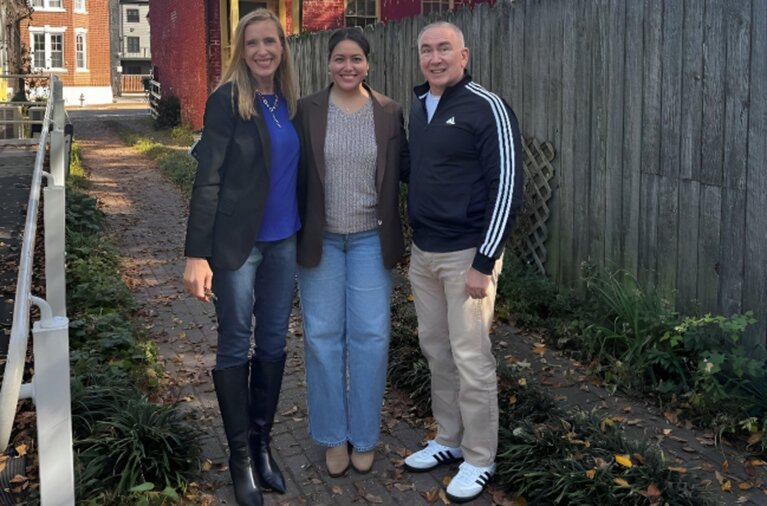
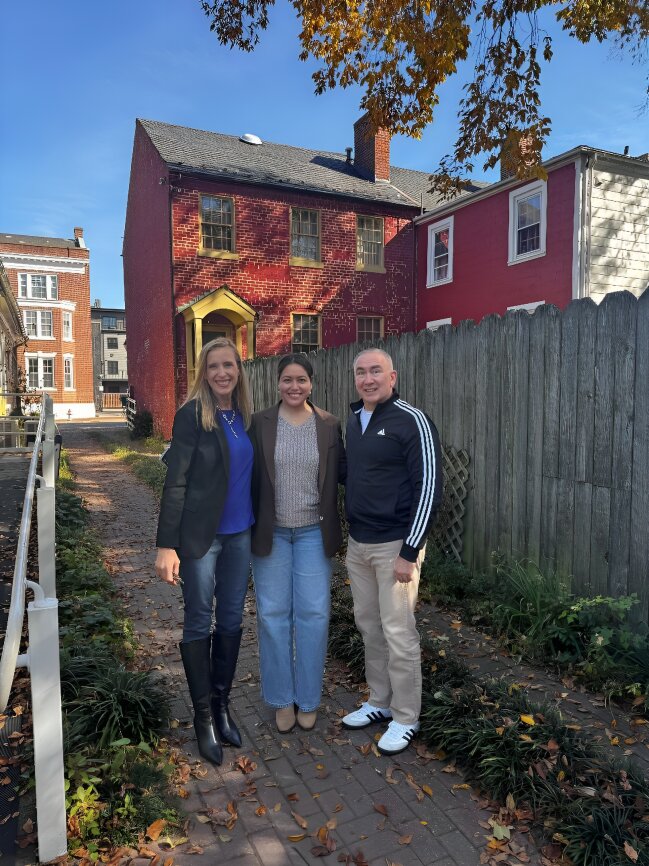
I was thrilled to meet up again with Steve Cox, President and CEO of Rappahannock Goodwill Industries, and Sofia DeHoyos, the organization’s Senior Director of Marketing. We met during a regional Fredericksburg area visit to Lynchburg, VA last month. Our team at The Green Mission Inc., and GM-ESG studies secondary markets in cities across the country, yet we rarely have the chance to do that work in our own hometown of Fredericksburg, Virginia. This relationship can change all of that and multiply the work that both of our organizations accomplish in our interconnected spheres.
Mr. Cox has summarized their organization’s purpose in a single line: “Ultimately, Goodwill is in the jobs business.” That sentence is why this meeting mattered so much to us as our team at The Green Mission Inc. (TGMI) and GM-ESG, have argued for years that reuse is more than an environmental preference, because it is also an economic engine that can support long-term, well-paid work. Rappahannock Goodwill is proving that argument every day, a short drive from our own front door.
Rappahannock Goodwill by the Numbers
In 2025, Rappahannock Goodwill served more than 10,500 people and reported 1,700 job placements, with an average placement wage of $22.59 per hour. The figures in this section come from the organization’s handout, Driving Economic Growth Through Workforce Development, unless another source is linked. According to Steve, this hourly wage achievement has actually risen since this last measurement.
Community impact measure | 2025 result |
People served | 10,500+ |
Job placements | 1,700 |
Placements with employer partners | 85% |
Average hourly wage at placement | $22.59 |
Coupons for clothing and household essentials distributed to local community partners for people in need | $115,000 |
Materials diverted from landfills, including electronic waste | 8+ million pounds |
That impact runs through a regional footprint of 15 stores, 21 donation centers, 3 career centers, and 2 e-commerce sites, supported by more than 300 employees across a 16-county service area. Over the past 20 years, the organization has served 155,000 individuals and placed 18,000 into local jobs. FXBG Neighbors reports that its 2025 results ranked third nationally among all Goodwill organizations, with a starting wage averaging more than $22 per hour.
The financial model is just as instructive, because retail sales provide approximately 84 percent of the revenue itemized below. Every donated sofa, coat, and lamp that sells is therefore funding career services, training, and community support.
Revenue source | Amount |
Retail sales | $19.5 million |
Grants | $1.5 million |
Custodial contracts | $1.2 million |
Other | $360,000 |
Cash donations | $200,000 |
Total (presented as $23 million on the handout) | $23.26 million |
The organization’s history shows how long this work has been building. Opportunities Unlimited was founded in Fredericksburg in 1966, joined Goodwill Industries International in 1991, and took the Rappahannock Goodwill Industries name. By 2022, it ranked as the third-largest nonprofit organization by revenue in the Rappahannock region. The Fredericksburg Regional Chamber of Commerce named it Large Business of the Year in 2023, and in 2025 it was recognized as a Virginia Talent + Opportunity Partnership Top Employer for Interns for the second consecutive year.
Its mission is to create jobs locally, prepare people to succeed at work, and remove barriers to employment so that individuals and families can thrive. Its vision is that people with barriers to employment, particularly those with disabilities, enjoy full economic and social participation in the community. In 2025, the organization redesigned its mission services around lasting careers, and in April 2026 it launched the CareerPath Accelerator, a signature program powered by artificial intelligence and led by people. Goodwill expects to serve more than 5,000 job seekers annually by the program’s third year.
Where Our Missions Meet
Rappahannock Goodwill, TGMI, and GM-ESG work on different parts of the same problem, which is how to keep useful goods and materials in circulation while creating real economic value. The organization’s reported 8 million pounds of material kept from landfills equals approximately 4,000 U.S. short tons. That total reflects material diverted through reuse, resale, recycling, and other recovery channels, rather than exclusively material returned to productive use. In The Macro-Economics of Reuse, I noted that the United States generates approximately 600 million tons of construction and demolition debris each year, and that local reuse channels can create jobs in salvage, logistics, and retail.
TGMI approaches the secondary market through deconstruction appraisals, waste diversion measurement, and sustainability reporting. Our IRS-qualified appraisals document the fair market value of reclaimed building materials, fixtures, furnishings, and appliances that property owners donate rather than discard. We also quantify material diversion and associated environmental impacts, providing organizations with measurable data to support their sustainability and ESG objectives. GM-ESG extends this work into corporate decommissioning and asset management, documenting the value of existing assets before they are removed, identifying opportunities for reuse, and modeling the financial and environmental benefits of sustainable replacement procurement. This includes evaluating avoided disposal costs, potential procurement savings, material recovery values, and associated carbon impacts. As I explained in The Secondary Market for Reclaimed Building Materials, every documented valuation contributes pricing evidence to a market that once relied heavily on informal transactions and limited market data. Together, TGMI and GM-ESG connect asset valuation, material recovery, financial analysis, and environmental reporting, helping organizations understand not only what leaves a building and where it goes, but also the economic and environmental value of keeping those materials in circulation.
Rappahannock Goodwill holds what most secondary market participants would envy: community trust, a dense network of donation points, a trained workforce, and proven retail and online channels. We bring valuation discipline, market data, tax expertise, and sustainability reporting. Those strengths are complementary, and that is why we are so excited to dive in locally.
A Market Moving in the Right Direction
The national data suggests that this relationship is forming at the right moment. Retail Dive reports that ThredUp’s 2026 Resale Report, conducted by GlobalData, projects the U.S. secondhand apparel market will reach $78.8 billion by 2030, growing at an average annual rate of about 7.3 percent. The same report projects a $393 billion global market by 2030 and found that the U.S. secondhand market grew nearly four times faster than the broader retail clothing market in 2025. ThredUp co-founder and CEO James Reinhart described the shift this way: “Resale is no longer just growing, it’s taking direct market share.”
Household budgets are driving much of that demand. Chain Store Age reports that 71 percent of surveyed shoppers said economic or financial concerns influenced their decision to buy or sell secondhand in the past year, and 56 percent pointed to the cost of living or inflation. Half of U.S. shoppers said concerns about tariff-related price increases made them more likely to consider buying certain items secondhand, and 95 percent own at least one type of item they believe they could sell or resell.
That last figure deserves attention, because it describes a supply of goods sitting in homes across our region. The same pressures are visible in building materials, where I have written that construction material prices rose 6.2 percent across 2025 while the global reclaimed lumber market is forecast to grow from $61.92 billion in 2026 to $74.13 billion by 2031. Reuse is no longer a fringe activity, and communities that build the local infrastructure for it will capture the jobs that follow.
When a Thrift Store Brings New Money to Town
The most exciting number in this story may be Goodwill’s e-commerce growth, because it changes what kind of jobs a thrift operation can support. Goodwill reports that its online operation grew from $400,000 to more than $3 million annually in just a few years, with dollars often arriving from buyers in states such as Texas and California. That is more than a sevenfold increase, and those dollars return to Fredericksburg to fund workforce programs.
Economic developers draw a useful distinction here, which should not be confused with our use of the term secondary market. Kelsey Bergen of the Aurora Development Corporation in Nebraska explains that primary jobs bring new money into a community by selling to customers outside it, while secondary or local-serving jobs depend largely on money already circulating there. Retail is typically placed in the second category, yet she also cautions that “Economic development is not about choosing one over the other.”
A Goodwill item sold to a buyer in Texas brings revenue into the Fredericksburg region from outside its local customer base. In that sense, online resale gives a traditionally local-serving retail operation some of the economic characteristics associated with an export-oriented business. That outside revenue can support local employment, operating expenditures, and workforce development programs. The resulting regional economic impact depends on how much revenue remains locally, the costs of fulfilling those sales, and the extent to which the activity generates additional employment and spending. The secondary market can therefore connect local-serving retail activity with an external revenue stream that supports regional economic development.
This is the logic I explored in Operating Leverage in the Secondary Retail Market. Occupancy and core labor are largely committed before the first sale of the day, so additional online and pooled-order revenue can absorb fixed costs that local foot traffic must otherwise carry alone. In that article’s hypothetical example, a 30 percent increase in revenue raised operating profit from $30,000 to $105,000 and operating margin from 3.0 percent to 8.1 percent, with gross margin held constant. That illustration is not an estimate of Goodwill’s results, and we do not claim that it is, but the principle applies to any operator already carrying a physical location.
Pooled inventory may be the next frontier. A contractor who needs forty matching interior doors cannot be served by one store holding six, yet a shared catalog across a regional network can assemble that order. With 15 stores, 21 donation centers, and 2 e-commerce sites, Rappahannock Goodwill already operates at a scale where the idea deserves serious local study, and we would be delighted to help examine it.
Building the Sustainability Metrics
Rappahannock Goodwill already has a powerful headline figure in its 8 million pounds of diverted material, and TGMI and GM-ESG are thrilled that our work can continue to build the measurement system beneath it. Good data turns a strong story into evidence that employers, grant makers, municipalities, and corporate donors can use. The City of Fredericksburg has already designated Goodwill as a vetted technology recycling provider, and the organization has recycled more than 2.2 million pounds of electronic waste through Dell Reconnect since 2014, so the demand for credible local reporting is plainly there.
The metrics we would be excited to develop together include:
- Diversion by material stream: pounds and tons of textiles, furniture, household goods, electronics, and other categories.
- Disposition tracking: the share of material resold in stores, sold online, sent to secondary salvage, recycled, or ultimately discarded.
- Avoided disposal cost: estimated tipping fees, hauling expenses, and other disposal costs avoided through reuse and recycling, calculated using documented material quantities, applicable local disposal rates, and clearly stated assumptions.
- Avoided emissions: greenhouse gas estimates using documented factors and a transparent, repeatable method.
- Reuse value: the market value of goods returned to productive use, supported by observed sales data.
- New money to the region: online revenue from buyers outside the 16-county service area.
- Jobs and wages per ton: a measure connecting environmental results directly to placements, payroll, and wage levels.
This last measure is the one I find most compelling, because few reports place the environmental and human returns on the same page. Corporate donors would benefit as well. Companies subject to greenhouse gas disclosure requirements, including qualifying businesses under California’s SB 253, increasingly need reliable emissions data and defensible methodologies for evaluating their environmental impacts. Material disposition records, reuse documentation, and lifecycle analysis can support broader sustainability reporting, although SB 253 does not independently require documentation of individual donated assets. For federal income tax purposes, donors claiming deductions exceeding $5,000 for an item or group of similar donated property generally must obtain a qualified appraisal and complete Form 8283, Section B, subject to statutory and regulatory exceptions. Similar items must be aggregated when determining whether the threshold is exceeded. Consistent documentation strengthens both environmental reporting and charitable contribution substantiation.
The Jobs a Stronger Secondary Market Can Build
Our region needs long-term, well-paid jobs that allow people to buy homes and pay their bills, and the secondary market can create more of them than most people realize. An average placement wage of $22.59 per hour translates to approximately $46,987 annually at 2,080 paid hours. As a purely illustrative calculation, 1,700 placements at that wage would represent approximately $79.9 million in annualized gross wages if every placement represented a full-time position sustained for an entire year. This is not a measure of actual annual payroll, incremental regional earnings, or Rappahannock Goodwill’s direct employment.
A single reclaimed door or donated sofa passes through many hands before it finds a new owner, and each stage can support skilled employment:
Stage of the secondary market | Examples of the work |
Collection and intake | Donation center staff, material receivers, sorters, and graders |
Deconstruction and salvage | Deconstruction crews, skilled trades, and material recovery specialists |
Repair and restoration | Furniture refinishers, appliance technicians, millwork and lumber processors, and electronics technicians |
Online sales | Product photographers, listing specialists, authenticators, and customer service staff |
Logistics | Warehouse managers, forklift operators, commercial drivers, and fulfillment staff |
Data and professional services | Inventory analysts, sustainability analysts, appraisers, and tax professionals |
These are categories of opportunity rather than a jobs forecast, and we intend to measure them honestly as the work develops. Many of them connect naturally to Goodwill’s existing strengths. The organization already helps participants pursue commercial driver’s licenses and information technology credentials, and its career centers and employer relationships provide a pathway into exactly this kind of work.
The multiplier effect matters as well. As the Aurora commentary observes, when workers spend their paychecks locally, that spending supports retailers, contractors, childcare providers, and restaurants. A secondary market that keeps goods, wages, and outside revenue circulating here strengthens all of them.
The Deconstruction and Labor Industry
The deconstruction industry offers another compelling example of how the circular economy can create skilled, labor-intensive, and human-centered employment. In Building the Circular Economy One Deconstructed Building at a Time, Caroline J. Marschall, COO of The Green Mission Inc., examines the work of Dave Bennink of RE-USE Consulting and other deconstruction professionals who are demonstrating how recovering building materials can support local businesses, workforce training, and long-term careers. Unlike conventional demolition, deconstruction requires workers skilled in carefully dismantling structures, identifying recoverable materials, preserving valuable architectural components, and preparing those materials for resale and reuse. These are jobs that require human judgment, technical knowledge, and hands-on craftsmanship. The economic opportunity is significant. According to Construction Coverage’s 2025 analysis of Bureau of Labor Statistics data, construction and extraction workers earned an average of $63,920 annually in 2024, although wages vary substantially by occupation and location. Payscale’s third-quarter 2026 Labor Market and Wage Trends Report also identifies strong wage growth in several skilled trades, including pipefitters and sheet metal mechanics, underscoring the value of specialized technical skills. While these figures represent broader construction occupations rather than deconstruction-specific wages, they illustrate the earning potential associated with developing a skilled workforce. As Bennink’s work demonstrates, building a successful deconstruction industry requires more than diverting materials from landfills. It requires training workers, developing viable businesses, and creating the infrastructure that allows recovered materials to return to the marketplace. That is where environmental stewardship and economic development become mutually reinforcing, turning buildings that would otherwise be demolished into opportunities for skilled employment, entrepreneurship, and lasting regional economic value. Yet another potential expansion in our local economy as building continues, building material prices increase and the secondary market for building material continues to come online.
Diving In Locally
Our team has spent years studying secondary markets in other people’s hometowns, and we are excited to bring that work home. I am deeply grateful to Steve Cox and Sofia DeHoyos for their time, and I look forward to exploring opportunities to work together to strengthen the secondary market here in Fredericksburg.
I said in September that we want reuse to become the first choice rather than the alternative. Rappahannock Goodwill shows what that can look like in a community: a donation becomes a sale, a sale funds a career center, and a career center places people in jobs averaging more than $22 per hour. We are excited to dive in locally and work with organizations like this one, because that is how sustainability becomes economic reality.
You can learn more about our work in sustainability, tax policy, valuation, and deconstruction appraisals at TheGreenMissionInc.com, GM-ESG.com, ProbityAppraisal.com, and MarschallTax.com.
Sources
- Rappahannock Goodwill Industries, Driving Economic Growth Through Workforce Development (handout)
- Operating Leverage in the Secondary Retail Market (GM-ESG, September 2026)
- The Macro-Economics of Reuse (GM-ESG, December 2025)
- The Secondary Market for Reclaimed Building Materials (The Green Mission Inc., July 2026)
- Understanding the impact of both primary, secondary jobs in our community (Aurora News-Register)
- US resale market expected to surpass $78B by 2030 (Retail Dive, April 3, 2026)
- Study: Secondhand shopping rises, fueled by economic concerns (Chain Store Age)
- From Donations to Careers (FXBG Neighbors, May 2026)
- From donations to destinations (Fredericksburg Free Press, sponsored content provided by Goodwill, December 15, 2025)
- New President and CEO for Rappahannock Goodwill Industries (Fredericksburg Free Press, October 18, 2019)
- City of Fredericksburg Works with Rappahannock Goodwill Industries for Technology Recycling (City of Fredericksburg, September 1, 2026)
- https://thegreenmissioninc.com/building-the-circular-economy-one-deconstructed-building-at-a-time/
Disclaimer: This article provides general information only and does not constitute tax, legal, or appraisal advice. Consult qualified professionals regarding your specific situation.