



A Decade of Deconstruction Appraisals
After nearly ten years of preparing IRS qualified, USPAP compliant appraisals for donations of deconstructed building materials, The Green Mission Inc. (TGMI) has seen the deconstruction donation evolve from a niche strategy into a widely marketed one, and with that growth has come a troubling persistence of valuation methods that the courts have already rejected. The deduction remains one of the rare places where environmental stewardship and tax policy point in the same direction, because it rewards property owners for keeping reusable materials out of landfills and placing them in the hands of nonprofits that resell them to the public at affordable prices. That alignment, however, holds only when the appraisal supporting the deduction is built on the right foundation, and this article revisits the fundamentals, the valuation approach the law actually requires, and the marketing gimmicks that continue to put taxpayers at risk.
…with that growth has come a troubling persistence of valuation methods that the courts have already rejected.
The Basics of a Deconstruction Appraisal
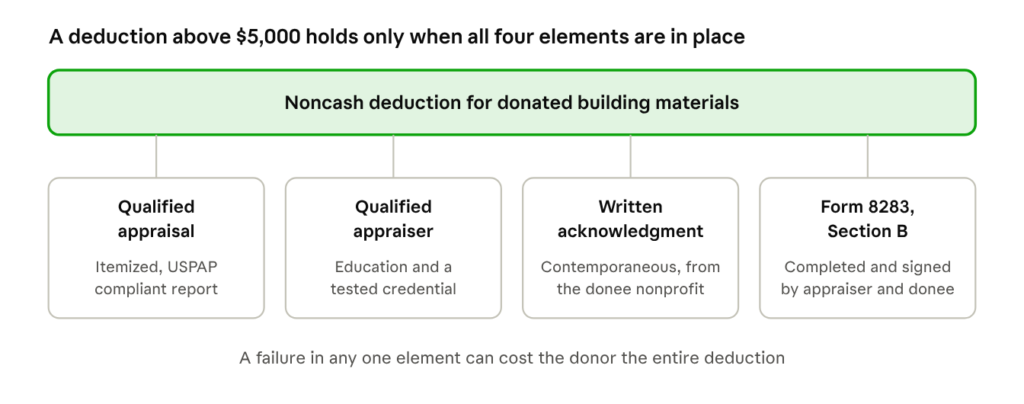
Our Deconstruction Appraisal Series lays out the framework in four parts, and the starting point is the substantiation regime Congress put in place under the Deficit Reduction Act of 1984 (DEFRA). A donor claiming a noncash deduction above $5,000 must obtain a qualified appraisal prepared by a qualified appraiser, secure a contemporaneous written acknowledgment from the donee organization, and complete Form 8283 correctly, and a failure in any one of those elements can cost the donor the entire deduction regardless of how generous the gift actually was.
The series identifies five recurring defects that expose donors, their CPAs, and their tax attorneys to disallowance and to penalties under Sections 6662 and 6695A:
- Defaulting to the Cost Approach rather than selecting a valuation approach through reasoned analysis and mandated personal property appraisal procedures.
- Applying arbitrary or unsupported depreciation factors to new construction costs.
- Asserting that no secondary market exists for used building materials.
- Misapplying cost segregation methodology, which was designed for depreciating real property and not for valuing donated personal property.
- Aggregating building components by square footage, including components that were never actually removed and delivered to the donee.
The remedy the series describes is an itemized inventory of the property the donee actually receives, with each item researched against settled sales in the secondary market where that kind of property is most commonly sold to the public. For salvaged building materials, that market is the architectural salvage, reuse retail, and auction marketplace, and TGMI maintains a proprietary database of more than 800 verified secondary market sources that maps most donated categories to documented settled sales as well as firm offers of sales based upon our research and conversations with secondary retailers. The series also notes that a properly prepared residential deconstruction appraisal typically requires 80 to 90 office hours, and some of the shortcut methodologies take around 30 minutes to produce
Why Deconstruction Donations Are Valued on Comparable Sales
The moment a cabinet, a window, a hardwood floor, or a staircase is detached from the structure, it ceases to be part of the real property and becomes personal property, and it must be valued as the personal property it now is. Fair market value for charitable purposes is the price at which the property would change hands between a willing buyer and a willing seller, neither under any compulsion and both having reasonable knowledge of the relevant facts, and the Treasury Regulations direct the appraiser to the market in which that property is most commonly sold to the public. For used building materials, that is the secondary market of reuse stores, architectural salvage dealers, and auctions, and the most direct evidence of value in that market is the price at which comparable items have actually sold.
Fair market value for charitable purposes is the price at which the property would change hands between a willing buyer and a willing seller, neither under any compulsion and both having reasonable knowledge of the relevant facts
This is why the Sales Comparison Approach is not merely our preference but the approach the governing authorities point toward. The IRS framework for qualified appraisals, the standards for personal property appraisal under USPAP, and the education and report review requirements of the personal property appraisal organizations that sponsor The Appraisal Foundation (the American Society of Appraisers, the Appraisers Association of America, and the International Society of Appraisers) all call for value to be supported by market evidence for the specific property donated, and a secondary market for salvaged materials plainly exists, even if it is still developing and uneven from one region to another.
What Mann and Loube Teach Us
The two federal precedents on deconstruction appraisals, Mann v. United States (D. Md., affirmed by the Fourth Circuit in 2021) and Loube v. Commissioner (T.C. Memo 2020-3), both ended with the taxpayer losing the entire deduction. In each case the appraisal applied an irregular version of a cost basis analysis in which construction quantities were plugged into estimating software such as R.S. Means, the resulting figures reflected the cost of new materials and new installation, and a depreciation factor was then applied (IRS determining it to be arbitrary) to arrive at a supposed value for used materials that had been pulled out of a house. In Mann, the court disallowed a claimed value of $313,353 and described the proper method as a Sales Comparison Approach applied to the property the donee actually removed. Neither appraisal answered the only question that matters, which is what a willing buyer in the secondary market would pay for those specific used items.
Deconstructed Materials Are Not Real Estate
A growing number of prospective clients are contacting TGMI after receiving quotes from other firms that value their donation as if it were the house itself, using real estate values or replacement cost figures that bear no relationship to what salvaged materials sell for. The same deconstructed home can produce dramatically different numbers depending on the method applied:
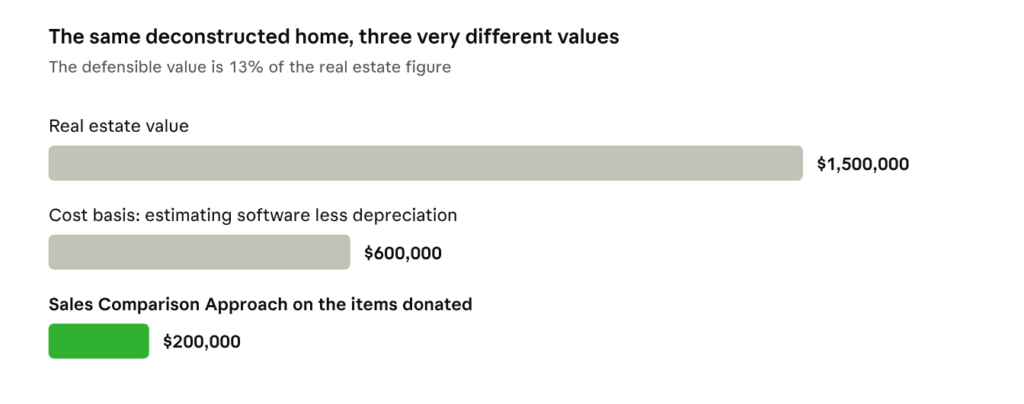
Valuation method | Illustrative value | Why it fails or holds |
Real estate value | $1,500,000 | Values the intact structure, not detached personal property delivered to a nonprofit and includes many materials that are either not salvageable or do not have value on the secondary market (drywall, nails, etc.) |
Cost basis with software and depreciation | $600,000 | The method rejected in Mann and Loube: new construction costs less an arbitrary depreciation factor |
Sales Comparison Approach | $200,000 | Itemized property valued on settled secondary market sales, as the law requires |
It is easy to see why appraisers quoting the first two figures remain in business, because a larger number is an easier sale to a property owner who is weighing the extra time and expense of deconstruction against conventional demolition. We regularly hear from clients that another company’s original estimate was double or triple our value, and our answer is always the same: the question is not which number is larger, but which number can be substantiated with market data when the IRS asks. Our number or methodology will not budge.
The Onus Is on the Taxpayer
The burden of substantiating the deduction rests with the taxpayer, not with the appraiser and not with the nonprofit. When a deduction is disallowed, it is the taxpayer who owes the additional tax and interest and who faces accuracy related penalties under Section 6662, which can reach 40 percent of the underpayment for a gross valuation misstatement. The appraiser’s own exposure under Section 6695A is modest by comparison, and the nonprofit that received the materials faces no penalty at all, which is precisely why the taxpayer and the taxpayer’s CPA must evaluate the methodology before the return is filed. Appraisal firms are still preparing reports this way today, and the taxpayers who rely on them are the ones left holding the liability. We were recently contacted by a client who received a 10 page determination letter from the IRS delineating why the appraisal failed and was not considered IRS Qualified. Unfortunately, we must inform the CPA and taxpayer that the window is closed to procure a qualified appraisal and the deduction is lost…and with that comes penalties, fines, back taxes and sometimes either the 20% misstatement penalty and other times 40%.
Gimmicks Promising Audit Protection
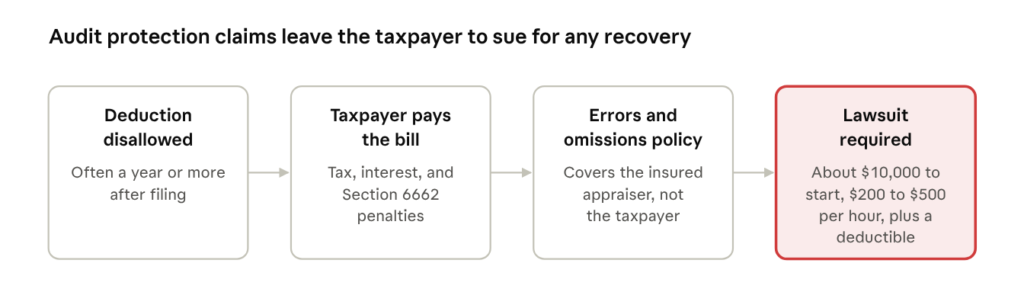
Alongside inflated values, some appraisers market their reports as “audit-proof” or claim that their insurance will protect the client if the IRS challenges the deduction. As we explained in Appraising Your Appraiser, our conversations with numerous insurance representatives led to a clear conclusion: insurance companies do not write policies that protect a third party from the consequences of the insured’s work in this way. Appraisal firms typically carry Errors and Omissions professional liability coverage, which responds only when a claim or lawsuit is filed against the appraiser, and which protects the insured appraiser rather than the unrelated taxpayer who relied on the report.
insurance companies do not write policies that protect a third party from the consequences of the insured’s work in this way.
In practical terms, a taxpayer whose deduction is disallowed would have to sue the appraiser to recover anything at all, with a simple lawsuit costing roughly $10,000 to initiate, attorney fees commonly running $400 to $900 per hour, and complex matters reaching six figures. Even if a claim succeeded, a deductible would apply, and it is fair to ask whether any appraiser could absorb that deductible for every client who is audited. Before relying on a promise of protection, a taxpayer should ask for a copy of the policy and confirm whether it truly guarantees full protection if the appraisal is found noncompliant, whether it covers the CPA and attorney fees incurred during the examination, whether it covers the underpaid tax, interest, and penalties that may surface a year or more after filing, and whether it reaches other items on the return that the IRS may review once an inquiry is open.
The article also cautions that years in business are not proof of qualification. A qualified appraiser should hold college level education supporting valuation methodology, current accreditation from a recognized personal property appraisal organization that was earned through testing and report review rather than grandfathered status, current USPAP education, and a clean record under Circular 230, and the appraiser should willingly provide the complete report to the client’s CPA. A full house deconstruction appraisal that arrives without comparables, methodology, photographs, descriptions, or a USPAP certification is not a qualified appraisal, no matter what assurances accompany it.
When a Nonprofit Requires a Single Appraiser
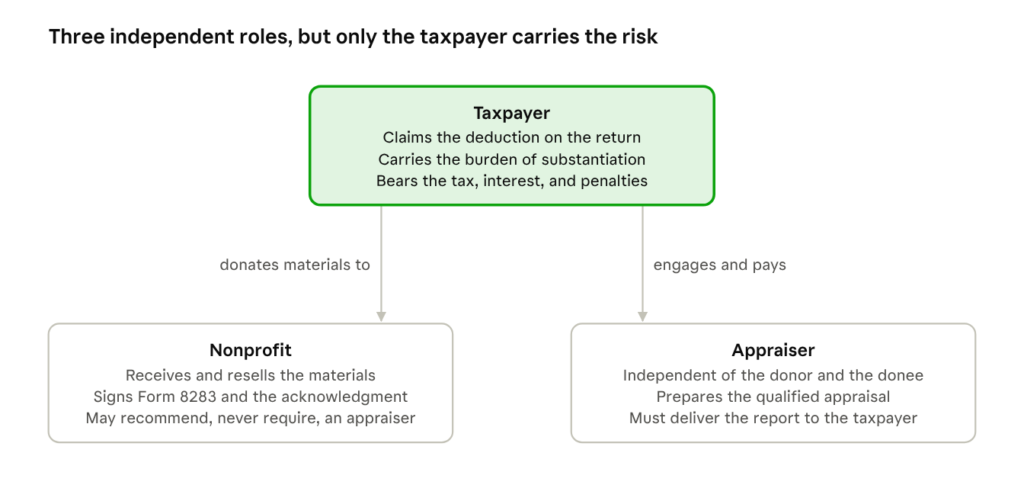
The taxpayer, the nonprofit, and the appraiser each have a distinct role, and the integrity of the deduction depends on those three parties remaining independent. As we described in Nonprofit, Taxpayer, Appraiser: Understanding Each Role, a nonprofit may recommend appraisers it trusts to produce compliant work, but it cannot require a taxpayer to use a particular appraiser, and we have encountered situations where that line was crossed with real consequences for the donor.
In one engagement, the nonprofit required the taxpayer to use its referred appraiser, and when the taxpayer’s CPA reviewed the return, there was no appraisal to support the donation. The appraiser told the client that an appraisal was unnecessary for a value below $500,000 because a signed Form 8283 would suffice, and the nonprofit and the appraiser had both signed the form without ever delivering a report. That position confuses two separate rules: the appraisal need not be attached to the return when building materials are valued below $500,000, but the appraiser must still prepare the qualified appraisal and provide a copy to the client. When the appraiser was finally pressed to produce a report, it ran five pages and was missing roughly 90 percent of the components that the American Society of Appraisers checklist identifies across sixteen required sections.
The taxpayer and CPA then engaged TGMI to prepare a retrospective replacement appraisal, which ran approximately 250 pages and concluded a value about 30 percent below the original figure, based on sales of comparable property in the correct secondary market. The nonprofit refused to sign Form 8283 unless the taxpayer used the original appraisal, and it went further by offering unsolicited advice that the taxpayer should claim the higher value and let the IRS reduce it. We advised the nonprofit that it is an independent party that cannot mandate the choice of appraiser, and that it should not dispense tax advice, particularly advice that would steer a donor toward filing an unsupported value. The lesson is the same one that runs through every section of this article: when the appraisal or the appraiser is not qualified, the party who loses is the taxpayer.
The nonprofit refused to sign Form 8283 unless the taxpayer used the original appraisal, and it went further by offering unsolicited advice that the taxpayer should claim the higher value and let the IRS reduce it.
Continuing the Work
TGMI is not interested in cornering the market on deconstruction appraisals. I am a busy woman with five children and four companies, and our firm will simply continue doing good work for good clients who seek to use this deduction as Congress authorized it and who are committed to meeting every requirement that comes with it. What our clients can depend upon is that we will keep current with our appraisal education, continue studying the underlying values in the secondary market for salvaged materials, and deliver accurate, well supported appraisals that stand on market evidence rather than on the largest number someone is willing to print.
Jessica I. Marschall, CPA, ISA AM President and CEO, The Green Mission Inc. and GM-ESG | President, MAS LLC | President, Probity Appraisal Group www.thegreenmissioninc.com | Info@TheGreenMissionInc.com
Sources
- The Deconstruction Appraisal Series, The Green Mission Inc., June 8, 2026
- Appraising Your Appraiser, The Green Mission Inc.
- Nonprofit, Taxpayer, Appraiser: Understanding Each Role, The Green Mission Inc., November 22, 2025