For over two decades, advocates of “deconstruction” and material reuse have touted the environmental and economic benefits of salvaging building components. Yet the secondary market for used building materials and furnishings has remained stubbornly underdeveloped, with low demand and low value relative to new goods. Today, however, a new factor is emerging that could tip the scales: escalating U.S. tariffs on a wide range of imported goods. As trade barriers drive up the cost of new building materials, appliances, and household items, the enormous price gap between new and used goods presents a timely opportunity to finally make reuse mainstream. But seizing this moment will require overcoming long-standing supply chain challenges through unprecedented coordination between nonprofits and for-profit firms.
In addition to our core Appraisal services, our team provides expertise in calculating an estimate of the original IRS Defined Cost Basis, which is a crucial aspect required for IRS Form 8283 Part 1 Section 3, box (f).
The choice of lumber used in residential home construction in the United States is heavily influenced by regional forest resources, climate conditions, and supply chain logistics. While most homes utilize standard dimensional lumber, the species and grades vary considerably based on location. This article outlines the most commonly used framing lumber types across major U.S. regions.
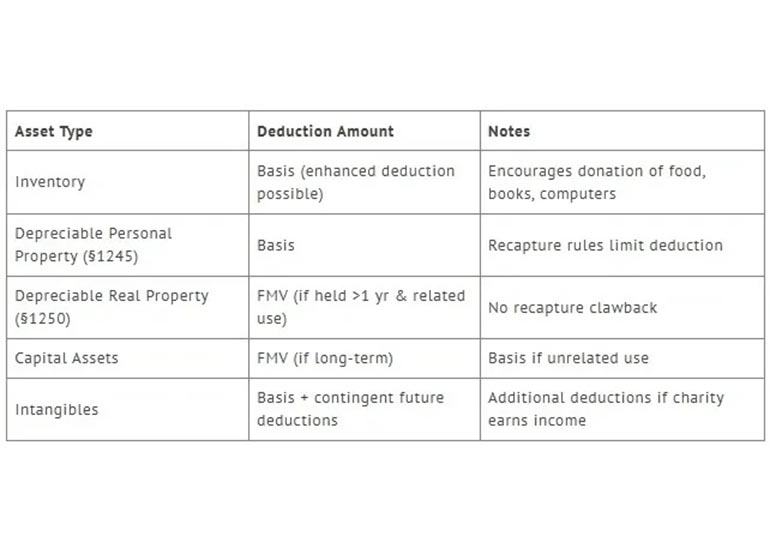
When making charitable contributions, taxpayers often consider donating either appreciated real estate or personal property. While both can yield significant tax benefits, the IRS applies different rules regarding deductibility, Adjusted Gross Income (AGI) limitations, and carryforward provisions. Understanding these distinctions can help donors maximize their tax benefits.
The valuation of materials and fixtures within real estate depends heavily on their attachment to the property versus their status as detached personal property. This principle is crucial in real estate appraisals, taxation, insurance, and donation valuations, particularly in the context of deconstruction and salvage. When components remain attached as part of an improvement, they typically carry higher value due to their contribution to the real estate’s utility, marketability, and financing potential. However, once removed, their value often declines due to depreciation, secondary market limitations, and diminished functionality in a different setting.
The Internal Revenue Code (IRC) Section 170 provides valuable tax incentives for C Corporations to donate inventory to qualified charitable organizations. Specifically, Section 170(e)(3) allows an enhanced charitable deduction for inventory donations, a provision designed to encourage businesses to contribute surplus goods to nonprofits rather than discarding them or selling them at a loss. Below, we explore the details of this provision, including how the deduction is calculated, substantiation requirements, and when an appraisal is necessary.
Non-cash charitable contributions, particularly those exceeding $5,000, have become a focal point for IRS enforcement and Tax Court rulings. While charitable giving provides an opportunity to benefit both the donor and the receiving organization, it also requires fastidious compliance with documentation requirements to withstand the heightened scrutiny of tax authorities. This article outlines key Tax Court cases, IRS substantiation rules, and proactive strategies for ensuring non-cash charitable contributions meet all necessary requirement.
Two decades after the inception of the “deconstruction” movement, the secondary market for reused building materials remains underwhelming in both demand and value. Despite tens of millions of dollars awarded to individuals and organizations for regional assessments, feasibility studies, model programs, and attempts to create uniform sales practices, the fundamental issues persist:
The Green Mission Inc. is thrilled to announce the formation of its Youth Coalition for Sustainable Deconstruction, an innovative initiative dedicated to gathering and amplifying the voices of young people with a passion for sustainable building practices. This coalition will serve as a vibrant platform for university students, trade students, emerging professionals, and anyone with a vested interest in the deconstruction industry. The Youth Coalition is designed to empower and inspire the next generation to engage with sustainable deconstruction practices and make meaningful contributions to a more circular economy.
The Green Mission Inc. has spent the past five years deeply involved in examining and reporting on the valuation metrics of the secondary market for building materials. As industry leaders in deconstruction valuations and sustainability practices, we have seen firsthand the significant untapped potential within this market. Through our work, we have identified strategies to maximize the value of salvaged materials while promoting sustainability. This article delves into how transforming the secondary market can create a more efficient, value-driven supply chain that benefits consumers, businesses, and the environment, unlocking new opportunities for growth and innovation.