

Pricing Trends, Market Dynamics, and the Case for Expanding the Secondary Lumber Market Through Deconstruction and Donation
By Jessica I. Marschall, CPA, ISA AM
President & CEO
The Green Mission Inc. | GM-ESG | Probity Appraisal Group | MAS LLC
February 2026
Introduction: Why Lumber Valuation Matters Now More Than Ever
By way of introduction, I have had the privilege of serving as President of The Green Mission Inc. (“TGMI”) since 2019, and our newly formed entity GM-ESG opened in 2025. We have a unique insight into the reclaimed building materials market, specifically lumber, as we value these materials at IRS-defined Fair Market Value for noncash charitable donation purposes. Thankfully, there are much smarter and abler individuals doing the hard work of deconstructing and salvaging these finite resources, as well as organizations studying the larger market and putting the pieces together to form a functional secondary market. However, we have a firsthand view of the inefficiencies in the current market for reclaimed building materials, as evidenced by the limited values these materials currently command, especially when compared with their new counterparts on the primary market. Consistent demand does not exist because adequate supply of fungible assets that can be delivered in a timely and dependable manner does not exist.
We hope that by sharing our transaction-level data and working with individuals in complementary industries, we can help to finally create a functional secondary market for used building materials.
Background
The U.S. lumber market stands at a critical inflection point. After years of dramatic volatility, from the pandemic-era highs that saw futures reach an all-time peak of $1,711 per thousand board feet in May 2021, to the subsequent correction and continued uncertainty through 2025, the market is now grappling with a convergence of forces that make accurate valuation both more important and more complex than at any point in recent memory.
Since opening TGMI in 2019, we have completed approximately 500 to 1,000 IRS-qualified deconstruction appraisals per year. I have had a front-row seat to the evolving relationship between new lumber pricing, reclaimed lumber valuation, and the tax policy mechanisms that connect the two through lumber donations and subsequent sales. This article examines the current state of the lumber market from a valuation perspective, identifies the structural barriers (from my perspective as a valuator) that prevent the reclaimed lumber market from reaching its full potential, and suggests a framework for catalyzing the kind of supply-side growth that will benefit property owners, the construction industry, and the environment in equal measure. I write from my perch as an observer of the market, fully reliant on the ingenuity of the actual deconstruction contractors and secondary market retailers to continue their critical work of extraction, salvage, and sale.
The Current State of the New Lumber Market
Futures Pricing and Recent Trends
As of late 2025, lumber futures were trading in the range of $530 to $557 per thousand board feet, which represents a roughly 5.5% decline from the prior year. The market narrative has been defined by oversupply, subdued housing starts, and a persistent inventory overhang created by early-2025 tariff-anticipation buying. Mills and distributors continue to carry elevated stock levels, while demand from both new homebuilding and renovation activity remains below historical norms.
The Producer Price Index for Lumber and Wood Products (FRED Series WPS081), published by the Bureau of Labor Statistics, registered 263.6 in September 2025 (Index 1982 = 100), reflecting a modest decline from the August reading of 269.1. For context, this index reached its peak during the pandemic-era lumber shortage, underscoring the extraordinary volatility the market has experienced in the span of just a few years.
Producer Price Index: Lumber and Wood Products (WPS081)
| Month | Index Value (1982 = 100) |
|---|---|
| September 2025 | 263.6 |
| August 2025 | 269.1 |
| July 2025 | 268.6 |
| June 2025 | 268.3 |
| May 2025 | 265.3 |
Source: U.S. Bureau of Labor Statistics, Producer Price Index by Commodity: Lumber and Wood Products: Lumber [WPS081], retrieved from FRED, Federal Reserve Bank of St. Louis.
Tariff Pressures and Supply Chain Disruption
The tariff landscape has become perhaps the single most significant variable in lumber pricing. The long-running U.S.–Canada softwood lumber dispute has escalated dramatically. As of late 2025, the cumulative tariff burden on Canadian softwood lumber exceeds 40% when combining countervailing duties (CVD), anti-dumping duties (AD), and the Section 232 national security tariffs imposed in October 2025. The U.S. Commerce Department nearly tripled anti-dumping duties from 7.66% to 20.56% following its annual review, while countervailing duties stand at 6.74% with expectations of increases to 14.38% or higher. The additional 10% Section 232 tariff on global imports of softwood timber and lumber (imposed October 14, 2025) further compounds the cost burden.
Canada accounts for approximately 85% of all U.S. softwood lumber imports and roughly one-quarter of the total available supply in the U.S. market. The National Association of Home Builders (NAHB) has estimated that recent tariff actions add an average of $9,200 in material costs per new single-family home. With housing affordability already near historic lows and mortgage rates remaining elevated, these tariffs function as an effective tax on American builders, home buyers, and consumers.
Cumulative Tariff Structure on Canadian Softwood Lumber (Late 2025)
| Duty Category | Rate | Notes |
|---|---|---|
| Anti-Dumping Duties (AD) | 20.56% | Nearly tripled from 7.66% in 2025 review |
| Countervailing Duties (CVD) | 6.74%–14.38% | Preliminary review suggests increase to 14.38%+ |
| Section 232 National Security Tariff | 10.00% | Imposed October 14, 2025 on global imports |
| Combined Effective Rate | 37.30%–44.94% | Varies by producer; some estimates exceed 40% |
Sources: U.S. Department of Commerce, International Trade Administration; NAHB; Congressional Research Service Report R48781.
Forward Outlook
Market forecasters anticipate lumber futures trading in the range of $484 to $534 per thousand board feet over the coming year, with potential upside driven by an expected increase in U.S. housing starts to approximately 1.5 million units in 2026, which is an 8–9% increase from 2025. Mill closures during 2024–2025 have reduced domestic production capacity by billions of board feet, and no major new mills are coming online in the near term. Wildfires, log shortages, and persistent labor challenges continue to constrain output. The convergence of tightening supply and recovering demand suggests that the current period of relative price stability may give way to renewed upward pressure.
The Reclaimed Lumber Market: Valuation Data and Market Dynamics
Global Market Size and Growth Trajectory
The global reclaimed lumber market has emerged as a significant and growing sector within the broader construction materials industry. Depending on the scope of measurement and methodology employed, market valuations range from approximately $57 billion to $63 billion in 2024–2025, with compound annual growth rates (CAGR) projected between 2.9% and 6.2% through the early 2030s. While the variance in estimates reflects differences in market definition, the directional trend is clear: this is a market in sustained expansion, even in light of some analyses including downstream processed products while others focus on raw reclaimed material
Reclaimed Lumber Market Size Estimates and Projections
| Research Firm | Current Valuation | Projected Value | CAGR |
|---|---|---|---|
| ResearchAndMarkets (2025) | $57.1B (2024) | $68.2B (2030) | 3.0% |
| Market Data Forecast (2025) | $60.7B (2024) | $92.8B (2033) | 4.8% |
| MMR Statistics (2026) | $60.9B (2025) | $76.7B (2032) | 2.9% |
| Market.us (2026) | $59.2B (2024) | $91.9B (2034) | 4.5% |
| Business Research Insights (2026) | $11.1B (2026) | $14.0B (2035) | 2.6% |
Note: Variations in market size estimates reflect differing methodologies and scope definitions across research firms. Directional growth trend is consistent across all sources.
Market Segmentation and Key Drivers
The reclaimed lumber market is segmented by application (flooring at 38.1% of demand, paneling and siding, beams and boards, and furniture), by end use (commercial, residential, and industrial), and by wood type (softwood at 56.9%, hardwood at 43.1%). End-use segmentation varies meaningfully across research methodologies: market.us reports commercial end use at 62.8% of the global market, while IMARC Group estimates commercial at 58.7% and Mordor Intelligence places it at 45.9%. Residential end use ranges from approximately 25–51% depending on the source and scope of measurement, with Market Data Forecast reporting residential at 50.7%—the highest estimate—driven by homeowner demand for reclaimed flooring, paneling, and custom furniture. Industrial end use (pallets, dunnage, racking, and other applications where dimensional tolerances are looser and durability outweighs aesthetics) consistently represents the smallest share, generally estimated at 5–15% of the market. The commercial segment is projected to register the highest CAGR—estimated at 4.8–8.2% across sources—reflecting corporate sustainability mandates, ESG reporting requirements, and the growing specification of reclaimed materials in hospitality, retail, and institutional projects. North America remains a primary market, though Asia Pacific has emerged as the largest regional consumer at 45.2% of global revenue, driven by rapid urbanization and growing environmental consciousness.
Several converging forces are propelling market growth. Environmental sustainability imperatives are at the forefront: the U.S. Environmental Protection Agency reports that construction and demolition activities generate approximately 600 million tons of waste annually, which is nearly double the volume of municipal solid waste, and demolition accounts for more than 90% of this figure. The U.S. Green Building Council recognizes reclaimed lumber’s contribution to LEED certification credits, further incentivizing adoption in green building projects. The growing consumer preference for rustic, vintage, and industrial aesthetics in interior design and architecture adds a powerful demand-side pull that transcends purely environmental motivations.
Reclaimed Lumber Pricing: Secondary Market Ranges
Reclaimed wood carries embedded value derived from its age, provenance, species characteristics, dimensional stability, and aesthetic qualities that cannot be replicated in newly harvested timber. Air-dried over decades or centuries, reclaimed structural lumber exhibits tighter grain patterns, superior dimensional stability, and a moisture content typically in the range of 12–13%. From a valuation perspective, the pricing of reclaimed lumber operates under a fundamentally different framework than commodity new lumber, and the ranges observed across the secondary market reflect wide variability driven by condition, preparation level, species, and regional demand.
The following table consolidates current secondary market price ranges across the major reclaimed lumber product categories. These ranges are derived from active dealer price lists, comparable sales data, and transaction records from multiple independent sources, including: Vintage Woods (Antique Woods and Colonial Restorations, NY), Colonial Barn Restoration Inc. (PA), East Coast Lumber, Cline Lumber, Appalachian Woods LLC (WV), Wood Vendors, City Limit Antiques and Reclaimed Materials, Beech Creek Timber, and Longleaf Lumber (MA/ME), as well as The Green Mission Inc.’s appraisal database of completed deconstruction projects. Market research data from Maximize Market Research and Homewyse further corroborate the ranges presented.
There are, of course, liquidation sales that sell for significantly less as well as higher outlier boutique sales.
Reclaimed Lumber Secondary Market Price Ranges
| Product Category | Unit | Price Range | Notes / Independent Corroboration |
|---|---|---|---|
| Structural Dimensional Lumber (1×6, 2×4) | Per Linear Foot | $1.50–$4.20 | Range reflects standard to antique age classification |
| Structural Dimensional Lumber (2×6) | Per Linear Foot | $4.00–$7.20 | Antique specimens command ~20% premium |
| Structural Dimensional Lumber (2×8) | Per Linear Foot | $8.00–$12.00 | Antique specimens command ~20% premium |
| Small Sawn Beams (3×5, 4×4, 3×6) | Per Linear Foot | $8.10–$14.00 | Colonial Barn reports $8.10–$10.00 for short lengths |
| Medium Beams (5×5–7×7), Sawn | Per Linear Foot | $14.00–$18.00 | Higher end for select species and longer lengths |
| Medium Beams (5×5–7×7), Hand Hewn | Per Linear Foot | $22.00–$27.00 | Colonial Barn: $8.10–$17.85 colonial grade by length |
| Large Beams (8×8+), Sawn | Per Board Foot | $5.00–$8.00 | Appalachian Woods: $5.00–$8.00/bf as-is lots |
| Large Beams (8×8+), Hand Hewn | Per Board Foot | $6.50–$10.00 | Colonial Barn: $9.52–$20.99/lf for 7×7–9×9 by length |
| Chestnut Beams (all sizes) | Per Board Foot | $10.00–$15.00+ | Scarcity of American chestnut drives premium |
| Antique Oak Beams (6×6) | Per Linear Foot | $25.00–$30.00 | City Limit Antiques: $30.00/lf for 6x6x15’ oak |
| Barn Board/Planking (as-is) | Per Board Foot | $1.00–$5.00 | Appalachian Woods: $1.00–$3.00/bf as-is gray weathered |
| Barn Board (kiln dried, de-nailed) | Per Board Foot | $4.35–$8.00 | Wood Vendors: from $4.35/bf KD de-nailed; avg $6–$8 |
| Barn Flooring (standard grade) | Per Square Foot | $9.00–$12.00 | Homewyse 2026 estimate: material $7.37–$10.40/sf |
| Vintage Flooring (select grade) | Per Square Foot | $12.00–$15.00 | Heart pine and rare species at upper range |
| Barn Siding (accent/feature wall) | Per Square Foot | $5.00–$8.00 | Weathered patina and character drive pricing |
| Re-Sawn Lumber (rough, mixed species) | Per Board Foot | $3.00–$6.00 | As-is condition; buyer mills to spec |
| Custom Fireplace Mantles | Per Linear Foot | $15.00–$40.00+ | Exceptional specimens exceed upper range |
| Joist and Rafter Systems | Per Linear Foot | $4.00–$8.00 | Typically priced per project |
| Complete Barn Frames | Per Frame | $15,000–$100,000+ | Size, condition, and species dependent |
Sources: Vintage Woods (vintagewoods.com); Colonial Barn Restoration Inc. published price list (colonialbarn.com); Appalachian Woods LLC current sale listings (appalachianwoods.com); Wood Vendors (woodvendors.com); City Limit Antiques and Reclaimed Materials; Beech Creek Timber; Longleaf Lumber; Homewyse 2026 cost guide (homewyse.com); Maximize Market Research reclaimed flooring estimates; The Green Mission Inc. appraisal database. Actual Fair Market Value for any specific lot depends on species, age, condition, preparation, provenance, and market conditions at the time of valuation.
New Lumber Comparison: Framing the Price Differential
To contextualize reclaimed lumber values, a comparison with new commodity lumber is essential. As of January 2026, Gordian’s RSMeans Data reports the national average cost of framing lumber at $872.03 per thousand board feet (MBF), reflecting a 3.44% decline from Q4 2025 but a 1.50% year-over-year increase. Lumber futures as of early February 2026 traded near $600/MBF, up approximately 2.75% from a year earlier. At the retail level, a new #2 SPF 2x4x8’ at a home improvement center currently runs approximately $3.38–$3.64 per stick (roughly $0.42–$0.46 per linear foot), while a 2x6x12’ runs approximately $5.84–$8.50 (roughly $0.49–$0.71 per linear foot). By contrast, reclaimed structural 2×4 lumber ranges from $3.50 to $4.20 per linear foot and reclaimed 2×6 from $6.00 to $7.20 per linear foot. This represents a multiple of roughly 8x to 10x over new commodity framing lumber at the retail level, reflecting the embedded characteristics of air-dried, old-growth material, the labor-intensive salvage and preparation process, and the aesthetic and sustainability premiums that reclaimed lumber commands.
The Processing Cost Factor
A critical dimension of reclaimed lumber pricing that is often underappreciated is the value created through processing. Data from Appalachian Woods LLC illustrates this vividly: as-is reclaimed timbers (with nails, surface deterioration, and no kiln drying) sell for $1.00 to $5.00 per board foot, while the same material de-nailed and kiln-dried commands $10.00 to $15.00 per board foot, a 2x to 10x increase depending on starting condition. E.T. Moore Manufacturing, one of the nation’s leading reclaimed heart pine specialists, reports that up to 55% of raw reclaimed material can be lost after sawing, straight-lining, end-trimming, and milling, meaning reclaimers effectively purchase twice as much wood as they sell. Beech Creek Timber notes that reclaimed barn wood generally ranges from $3 to $22 per board foot across the full spectrum from raw stock to finished product, with species, size, age, condition, and services like kiln drying and metal detection all factoring into the final price. These processing economics are central to understanding both current market pricing and the opportunity to increase reclaimed lumber values through investment in preparation infrastructure.
Key Pricing Observations
Several patterns emerge from the data that are critical for appraisers, property owners, and market participants to understand. First, the hand-hewn premium is substantial and consistent: hand-hewn beams command 50–70% more than sawn beams of equivalent dimension, reflecting both the aesthetic premium buyers place on visible tool marks and the inherently limited supply of genuinely hand-hewn material. Second, antique-classified structural lumber (100+ years) commands approximately a 20% premium over standard and vintage structural lumber of the same dimension, reflecting scarcity, superior old-growth characteristics, and collector demand. Third, the spread between the lowest-value reclaimed products (rough re-sawn lumber at $3.00 per board foot) and the highest-value finished products (select-grade flooring at $15.00 per square foot, custom mantels at $40.00+ per linear foot) illustrates the enormous value that processing, grading, and preparation add, which is a point with direct implications for the economics of deconstruction and for strategies to strengthen the secondary market.
It is important to note that these ranges represent current market conditions shaped by the structural limitations discussed in the following section. As the secondary market matures—with more consistent supply, standardized grading, and improved aggregation infrastructure—upward pricing pressure across all categories is anticipated, particularly for graded, milled, and project-ready material.
Structural Barriers to a Thriving Secondary Lumber Market

Despite favorable macro trends, including rising environmental consciousness, growing consumer preference for reclaimed aesthetics, escalating new lumber costs driven by tariffs, and a global market projected to nearly double by 2034, the reclaimed lumber market continues to face structural barriers that prevent it from reaching its full potential. From a valuation perspective, these barriers directly suppress Fair Market Values by limiting the conditions necessary for an efficient market to function.
Inconsistent Supply
The most fundamental challenge is the absence of reliable, consistent supply. Unlike new lumber, which flows through established mill-to-distributor-to-retailer channels with predictable volumes and specifications, the reclaimed lumber supply chain is inherently fragmented. Materials become available episodically, like when buildings are deconstructed, when barns are dismantled, when renovation projects generate salvageable wood, and the subsequent timing, volume, and quality of available material are unpredictable. This inconsistency makes it extremely difficult for architects, contractors, and designers to specify reclaimed lumber with confidence, because they cannot guarantee that the materials they need will be available when they need them, in the quantities they require. Supply unpredictability suppresses demand, which in turn suppresses pricing, which in turn reduces the economic incentive for deconstruction, creating a self-reinforcing cycle of market underdevelopment.
Inconsistent Grading and Preparation Standards
New dimensional lumber benefits from rigorous, universally understood grading systems administered by organizations such as the American Lumber Standard Committee and enforced through accredited grading agencies. Buyers know exactly what they are getting when they order “#2 SPF 2×6.” No equivalent standardized grading system exists for reclaimed lumber. One dealer’s “select grade” reclaimed oak flooring may differ significantly from another’s in terms of allowable nail holes, checking, wane, moisture content tolerance, and dimensional accuracy. This inconsistency introduces risk for buyers, particularly on commercial projects where specifications must be precise and performance must be guaranteed. The absence of standardized grading also complicates appraisal work, because Fair Market Value determinations require comparable transactions involving materially similar goods; a standard that becomes difficult to meet when the goods themselves lack consistent classification.
Inability to Fulfill Bulk Orders
Commercial and institutional projects require large volumes of consistent material, often hundreds or thousands of board feet of dimensionally matched, species-consistent lumber. The current reclaimed lumber market, composed primarily of small-scale salvage operations, individual barn deconstructors, and local reuse centers, is poorly equipped to aggregate the volumes needed for bulk orders. A commercial renovation specifying 5,000 square feet of reclaimed white oak flooring cannot reliably source that volume from a single supplier at consistent quality. This forces project teams to either source from multiple suppliers (introducing inconsistency) or default to new materials. The inability to fulfill bulk orders at scale represents perhaps the single greatest barrier to reclaimed lumber’s penetration of the commercial construction market, which accounts for 62.8% of end-use demand globally.
Building the Infrastructure: What It Takes to Bring Reclaimed Lumber to Market at Scale
Transforming the reclaimed lumber market from a fragmented niche into a reliable, scalable supply chain requires coordinated action across several dimensions. Drawing on more than two decades of experience working at the intersection of tax policy, appraisal standards, and six years of observing deconstruction operations, the following framework is what many of us have landed upon as critical ongoing steps.
Establishing Consistent Supply Through Expanded Deconstruction
The supply of reclaimed lumber is, at its core, a function of how many buildings are deconstructed rather than demolished. Expanding deconstruction activity requires both regulatory and economic levers. On the regulatory side, municipal deconstruction ordinances (already adopted or under consideration in cities including Portland, Milwaukee (somewhat), San Antonio, Pittsburgh, Palo Alto, and Boulder) have proven effective at diverting demolition waste and generating reclaimed material supply. These ordinances typically require that buildings above a certain age or size be deconstructed (materials salvaged for reuse) rather than mechanically demolished. On the economic side, the charitable contribution tax deduction for donated salvaged materials remains the single most powerful incentive for property owners to choose deconstruction (especially residential). When property owners donate salvaged materials—including lumber, fixtures, cabinetry, and architectural elements—to qualified 501(c)(3) organizations, they may claim a charitable contribution deduction equal to the Fair Market Value of the donated materials, subject to IRS requirements for qualified appraisals, Form 8283 compliance, and contemporaneous written acknowledgment.
Developing Standardized Grading and Preparation Protocols
The industry continues to need a nationally recognized grading standard for reclaimed lumber comparable in rigor and specificity to the grading systems that govern new dimensional lumber. Such a standard would establish clear categories based on species, age classification (structural, vintage, antique), dimensional tolerances, allowable defects (nail holes, checking, wane, mortise holes), moisture content, and preparation level (as-is, de-nailed, kiln-dried, milled to specification). Organizations such as Build Reuse (formerly the Building Materials Reuse Association) are well-positioned to lead this standardization effort, potentially in collaboration with existing lumber grading bodies. Standardized grading would dramatically improve buyer confidence, enable accurate specification in architectural and engineering documents, and provide the consistent comparable transaction data that supports defensible Fair Market Value determinations.
Creating Aggregation and Distribution Infrastructure
Meeting bulk order requirements demands the creation of regional aggregation facilities, or central locations where reclaimed lumber from multiple deconstruction projects can be received, inventoried, graded, processed (de-nailed, milled, kiln-dried as needed), stored, and distributed. These facilities would function as the reclaimed lumber equivalent of new lumber distribution yards, providing the inventory depth and consistency that commercial buyers require. Nonprofit reuse centers such as Habitat for Humanity ReStores already provide a partial model, but the scale, specialization, and inventory management sophistication needed for commercial-grade supply requires dedicated infrastructure investment. The economic case for such facilities strengthens as supply volumes increase, which is precisely why expanding deconstruction activity is the necessary first step.
The Virtuous Cycle: How Expanding Deconstruction Creates Market Momentum
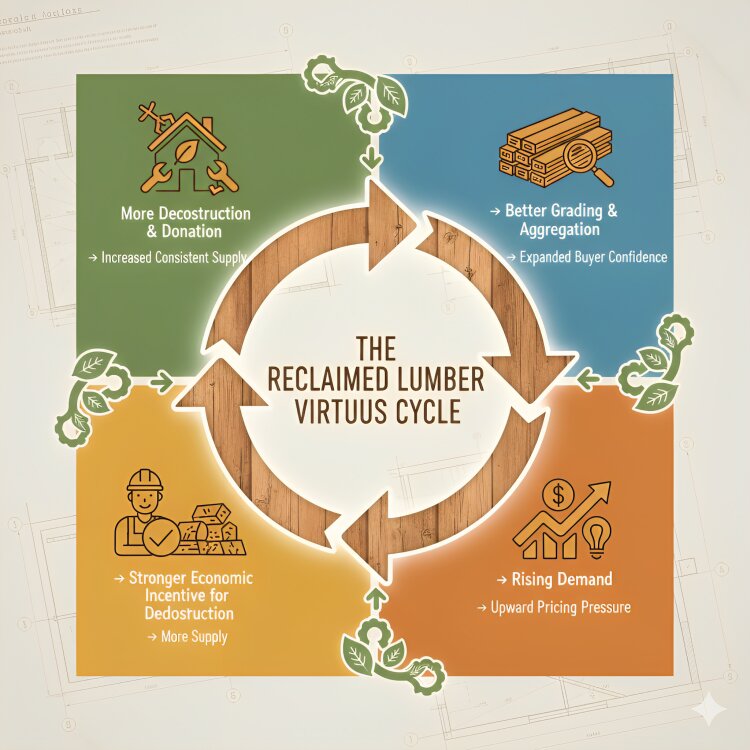
The economics of the reclaimed lumber market contain a powerful self-reinforcing dynamic that, once activated, can generate sustained growth. The cycle operates as follows:
THE RECLAIMED LUMBER VIRTUOUS CYCLE
More Deconstruction & Donation → Increased Consistent Supply
→ Better Grading & Aggregation → Expanded Buyer Confidence
→ Rising Demand → Upward Pricing Pressure
→ Stronger Economic Incentive for Deconstruction → More Supply
The critical insight from a valuation perspective is that Fair Market Value in the reclaimed lumber market is currently suppressed not because the inherent value of the material is low, but because the market infrastructure is underdeveloped. When reclaimed lumber can be reliably sourced, consistently graded, and delivered in commercial quantities, its Fair Market Value will more accurately reflect the genuine premium that old-growth, dimensionally stable, aesthetically distinctive wood commands over commodity new lumber. The 20% premium already observable in antique-classified structural lumber (compare $4.20 per linear foot for antique 2×4 to $3.50 for standard structural) represents just the beginning of what a mature, well-functioning secondary market will produce.
Actionable Strategies to Encourage Deconstruction and Donation

Strengthen and Publicize the Tax Incentive Framework
The charitable contribution deduction for donated building materials remains underutilized, in large part because property owners, developers, and their tax advisors are unfamiliar with the mechanism. For individual taxpayers who itemize, the deduction equals the Fair Market Value of donated materials, with a five-year carryforward available for amounts exceeding annual AGI limitations. For corporations, the deduction is limited to 10% of taxable income with a five-year carryforward, though certain enhanced deductions may be available for donations of inventory. The One Big Beautiful Bill Act (OBBBA), passed in 2025, introduces changes beginning in the 2026 tax year that will affect charitable giving dynamics, including a new above-the-line deduction for non-itemizers (up to $1,000/$2,000 for single/joint filers) and new limitations for high-income itemizers. Professional education and outreach to CPAs, tax attorneys, real estate developers, and commercial property managers about these benefits would significantly increase deconstruction adoption.
Expand Municipal Deconstruction Ordinances
Cities that have adopted deconstruction ordinances have demonstrated measurable increases in material recovery and reuse. These ordinances should be expanded to more municipalities, with particular emphasis on requiring deconstruction for publicly funded demolition projects. State-level legislation requiring deconstruction assessments before demolition permits are issued (even if not mandating deconstruction in all cases) would create a systematic review process that identifies high-value salvage opportunities currently being lost to conventional demolition.
Invest in Deconstruction Workforce Development
Deconstruction is a labor-intensive process requiring skilled workers who understand structural systems, material identification, safe disassembly techniques, and proper preparation for reuse. Workforce development programs, apprenticeship models, and technical training curricula specific to deconstruction would expand the available labor pool, reduce per-project costs, and improve the quality and consistency of salvaged materials; directly addressing the grading and preparation challenges identified earlier.
Catalyze Regional Aggregation Through Public-Private Partnership
State and local governments can play a catalytic role by providing land, infrastructure support, or startup funding for regional reclaimed lumber aggregation and distribution facilities. These facilities, potentially operated as social enterprises or nonprofit-private partnerships, would provide the inventory concentration, quality control, and commercial distribution capability that the market currently lacks. Even modest initial investment in two or three strategically located pilot facilities could demonstrate the model’s viability and attract private capital for replication.
Leverage Environmental and ESG Reporting Requirements
As corporate environmental, social, and governance (ESG) reporting requirements expand, companies engaged in building renovation, campus redevelopment, and facility decommissioning face increasing pressure to demonstrate sustainable practices. Deconstruction and lumber donation provide documented, quantifiable environmental impact metrics, including tons diverted from landfill, carbon emissions avoided, LEED credits earned, that support ESG compliance objectives. Positioning deconstruction as an ESG strategy, not merely a tax planning technique, broadens its appeal to a much larger universe of institutional and corporate decision-makers.
Make It Profitable: The Case for Rigorous Financial Modeling

I want to be direct about something. For two decades, the deconstruction and reclaimed lumber industry has been built primarily on the nonprofit model, sustained by grant funding, charitable donation incentives, and the moral argument that salvaging building materials is the right thing to do for the environment. That foundation has accomplished a great deal. It has proven the concept, built awareness, and created the earliest supply chains. But it has not produced a scalable, self-sustaining market, and in the current political and economic climate, the environmental argument alone is no longer sufficient to drive the investment and participation this industry requires.
Millions of dollars in grant funding have been spent studying this market. There are feasibility studies, pilot programs, academic analyses, and policy white papers filling filing cabinets and digital archives across the country. I do not believe millions more need to be spent on further study. What is urgently needed is something far more fundamental and far more difficult: detailed, fully costed revenue and margin models that demonstrate, in the language investors and business operators actually speak, that deconstruction and reclaimed lumber can generate returns that meet or surpass alternative investment opportunities.
Firm Margins Across the Value Chain
The reclaimed lumber value chain has identifiable participants at every stage: deconstruction contractors who perform the physical work, nonprofit or for-profit recipients who receive and process the material, wholesalers and aggregators who consolidate and grade inventory, and retailers and end-use fabricators who sell to the final buyer. Each of these participants incurs real costs and must earn margins sufficient to justify their participation. Yet in our consulting work with industry members seeking joint ventures and partnerships, we have yet to see a fully costed market model that integrates firm economic, market, finance, and accounting concepts across these stages. Instead, we see a great deal of good intention and hypothetical market adaptation, projections built on assumptions rather than auditable numbers, and business plans that treat profitability as a hoped-for outcome rather than an engineered requirement.
What must exist, and what we will continue to consult toward building, is a model that answers concrete questions with defensible numbers. What does it cost a deconstruction contractor, per square foot of structure, to perform selective disassembly versus mechanical demolition, inclusive of labor, insurance, equipment, disposal of non-salvageable material, and transportation? What margin does the contractor require to choose deconstruction over demolition absent any tax benefit or grant subsidy? What does the recipient organization spend per board foot to receive, sort, de-nail, grade, kiln-dry, and inventory reclaimed lumber, and at what sell-through rate and price point does that operation break even? What does a wholesale aggregation facility require in throughput volume, average selling price, and operating margin to service debt, cover overhead, and return capital to investors? These are not theoretical questions. They are the questions that every investor, lender, and business operator asks before committing capital to any venture, and this industry must answer them with the same rigor applied to any other emerging market opportunity.
Beyond the Nonprofit Model
The charitable donation framework has been, and will continue to be, a powerful tool. When a property owner receives a tax deduction that exceeds their net cost of deconstruction, the economic case for salvage is compelling, and TGMI’s portfolio of millions in substantiated deductions proves that the mechanism works. But the donation model has inherent limitations. It depends on the property owner’s tax position. It requires qualified appraisal, which adds cost and complexity. It has, at times, been accompanied by questionable charitable donation values that undermine the credibility of the entire framework, invite IRS scrutiny, and make legitimate practitioners’ work harder. Most importantly, it does not by itself create a profitable commercial market for reclaimed lumber. The donation creates supply. It does not create the downstream economic engine that converts that supply into revenue, margin, and reinvestment.
For twenty years, the attitude of doing the right thing for the environment has been the industry’s leading message. That message resonated during periods of broad bipartisan environmental consensus. We no longer have that luxury, particularly in the face of current political headwinds that treat sustainability initiatives with skepticism or outright hostility. People need to choose deconstruction because they can make money doing it. The fact that they may simultaneously be saving millions of tons of finite resources from reaching landfills and preventing construction waste from seeping contaminants into our drinking water must be secondary. Not unimportant. Secondary. The environmental benefit is the dividend, not the investment thesis.
A Call to Market Participants
We urgently encourage every participant in this industry, from deconstruction contractors and material recipients to technology developers and potential investors, to approach the reclaimed lumber market as what it is: an emerging market with enormous upside, real barriers to entry that create competitive advantage for early movers, and a value chain that can be modeled, costed, and optimized using the same tools applied to any other commodity or building products market. Build the pro forma. Stress-test the assumptions. Model the sensitivity to lumber price fluctuations, labor cost escalation, and policy changes. Show investors an internal rate of return. Show lenders a debt service coverage ratio. Show operators a path to positive cash flow that does not depend on the next grant cycle.
Our group will continue to consult on this larger model, bringing to bear decades of experience in tax advisory, valuation, and financial analysis. But the work of building a profitable industry cannot rest on any single firm or organization. It requires market participants who are willing to treat deconstruction as a business first, build financial models that would survive due diligence from a private equity firm or a commercial lender, and price their services and products at levels that generate sustainable margins. Do that, and the capital will follow. Do that, and the environmental benefits, the landfill diversion, the carbon reduction, the resource conservation, become the extraordinary aftereffects of a profitable enterprise. There is no contradiction between making money and doing good. The reclaimed lumber market simply needs to prove, with numbers, that both are possible at the same time.
Conclusion: The Convergence Opportunity

The lumber market in 2026 presents a rare convergence of conditions that, properly leveraged, can catalyze transformative growth in the secondary reclaimed lumber market. New lumber prices face sustained upward pressure from escalating tariffs, constrained domestic mill capacity, and recovering housing demand. The global reclaimed lumber market is already on a multi-decade growth trajectory driven by sustainability imperatives, aesthetic preferences, and regulatory evolution. The tax incentive framework for charitable donations of building materials provides a proven, powerful economic mechanism for expanding deconstruction activity, the essential supply-side driver of a healthy secondary market.
What is needed now is coordinated action to address the structural barriers outlined, including inconsistent supply, absence of standardized grading, and inability to fulfill bulk commercial orders, that prevent the reclaimed lumber market from achieving its potential. Every building deconstructed rather than demolished adds material to the supply pipeline. Every donation appraised and documented to IRS standards strengthens the data foundation that supports defensible Fair Market Values. Every municipal ordinance, workforce training program, and aggregation facility investment moves the market closer to the tipping point where the virtuous cycle of supply, demand, and pricing becomes self-sustaining.
I can attest that the tools to build this market exist. The economics work. The tax law supports it. The environmental case is unassailable. What remains is the will to invest in the infrastructure and education needed to connect these elements into a functioning system. The opportunity is here. The time to act is now.
About the Author

CPA, ISA AM President & CEO The Green Mission Inc.
Jessica I. Marschall, CPA, ISA AM serves as President and CEO of The Green Mission Inc., GM-ESG, Probity Appraisal Group, and MAS LLC. With 26 years of CPA experience serving over 400 clients annually, she has completed approximately 500-1,000 IRS-qualified deconstruction appraisals annually substantiating charitable deductions. She serves on the Board of Rethos, a historic preservation nonprofit focused on reimagining buildings for modern community needs, and serves as President of the Stafford Education Foundation. She may be reached at info@thegreenmissioninc.com or (540) 322-3884.
Sources and References
- Trading Economics. Lumber Price—Chart—Historical Data.
- U.S. Bureau of Labor Statistics. Producer Price Index by Commodity: Lumber and Wood Products: Lumber [WPS081]. FRED, Federal Reserve Bank of St. Louis.
- Gordian. RSMeans Data: Lumber Price Updates (January 2026).
- Vintage Woods (Antique Woods and Colonial Restorations). Current Price List.
- National Association of Home Builders (NAHB). Publications on lumber tariffs and housing affordability (2025).
- U.S. Department of Commerce, International Trade Administration. Final Results of Anti-Dumping Duty Review on Canadian Softwood Lumber (2025).
- Congressional Research Service. U.S.-Canada Softwood Lumber Trade: Current Issues for Congress. Report R48781 (December 2025).
- Market Data Forecast, ResearchAndMarkets, MMR Statistics, Market.us, Business Research Insights. Various Reclaimed Lumber Market Reports (2025–2026).
- U.S. Environmental Protection Agency. Construction and Demolition Debris Statistics.
- Tax Foundation. Changes to Charitable Giving Under the One Big Beautiful Bill Act (November 2025).
- The Green Mission Inc. Comparable Sales Data: Lumber Comparable Sales for Appraisal (Internal database).
- Colonial Barn Restoration Inc. Reclaimed Lumber Pricing.
- Appalachian Woods LLC. Current Lumber Sale Items.
- Wood Vendors. Reclaimed Lumber.
- Beech Creek Timber. How Much Does Barn Wood Cost? Price Ranges Explained.
- City Limit Antiques and Reclaimed Materials. Antique Oak Barn Beams listing.
- E.T. Moore Manufacturing. How Much Does Reclaimed Heart Pine Flooring Cost?
- Homewyse. Reclaimed Wood Flooring Cost Guide (January 2026).