

By Jessica Irving Marschall, CPA, ISA AM President and CEO, The Green Mission Inc. and GM-ESG | President, MAS LLC | President, Probity Appraisal Group
Introduction: Three Days in the Hill City
From October 14 through 16, 2026, I joined dozens of business, education, government and nonprofit leaders from across Planning District 16 on the Fredericksburg Regional Chamber of Commerce’s Regional InterCity Visit to Lynchburg, Virginia. The Chamber chose Lynchburg because it is widely regarded as one of the Commonwealth’s most collaborative regions, a place where employers, educators, local government and civic organizations have aligned around a shared regional vision rather than competing jurisdiction by jurisdiction.
The theme of the visit was “Leverage What You’ve Got,” and it proved to be an apt lens for everything we saw. Lynchburg sits in the foothills of the Blue Ridge along the James River, and over the course of three days we watched a mid-sized city put its historic buildings, its riverfront, its manufacturing base, its universities and its heritage sites to work in a deliberate and coordinated way. Board Chair Ginni Matern framed the challenge plainly at the outset: the measure of the trip would not be how much we saw, but what we do with those ideas once we return home ahead of the Chamber’s Regional Stakeholders Meeting on November 17.
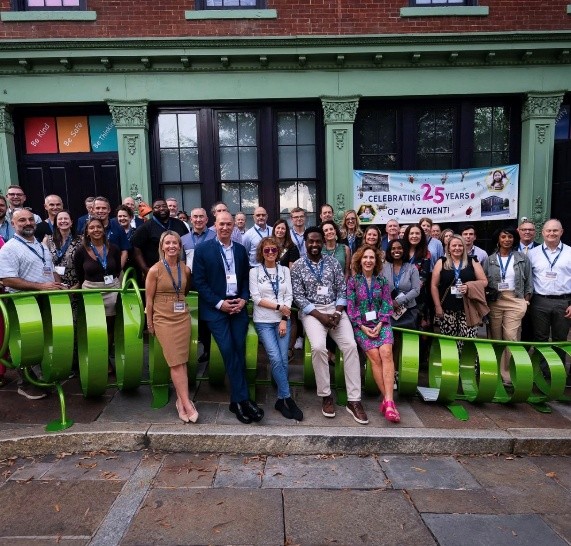
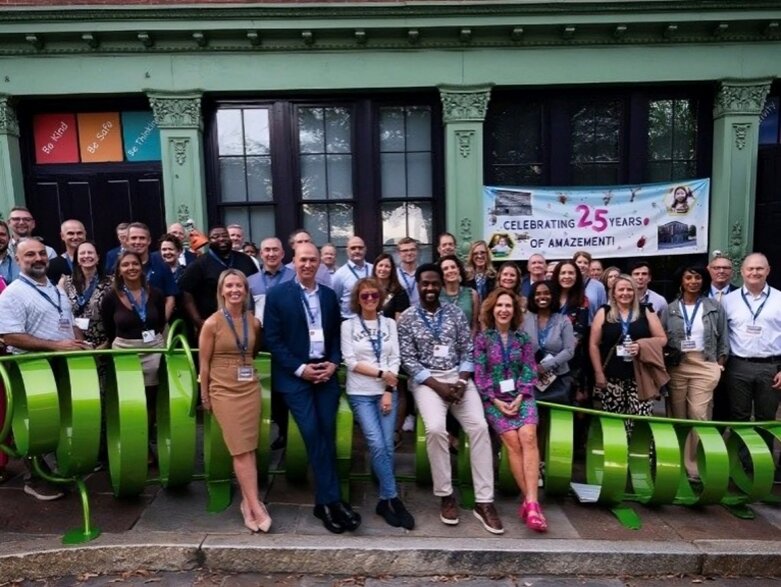
Our itinerary moved from the restored Virginian Hotel, which served as our home base, to a welcome dinner inside Amazement Square, a children’s museum built within an 1860s riverfront warehouse. Thursday took us to the Lynchburg Regional Business Alliance, to the Vector Space makerspace, through the Aerofin manufacturing plant, into a summit on the region’s energy and data center niche, and finally to the new Riverfront Amphitheater, where William Cook, President of Jamerson-Lewis Construction, shared what it took to bring that venue from vision to opening night. Friday began at Thomas Jefferson’s Poplar Forest and closed at Liberty Mountain Snowflex with a panel on building the region’s talent pipeline.
I attended with three professional lenses that shape how I see any community. As a CPA of more than two decades and President of MAS LLC, I look at how projects are financed and whether the numbers hold up over time. As President and CEO of The Green Mission Inc. and GM-ESG, I look at the built environment as an inventory of materials that can be preserved, reused, salvaged or donated rather than landfilled. As President of Probity Appraisal Group and an accredited appraiser, I look at what things are worth and why. Lynchburg rewarded all three perspectives, and the two articles that follow focus on the stops where those perspectives converged most clearly.
Poplar Forest: A Three-Decade Lesson in Patient Restoration
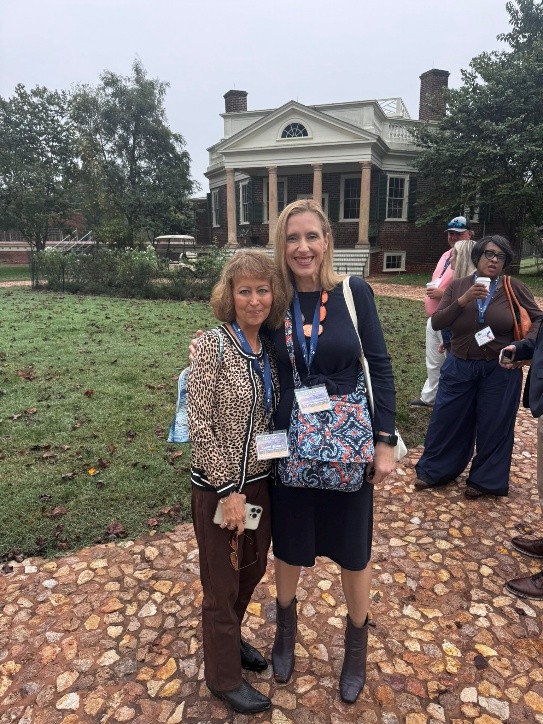
No stop on the itinerary illustrated the value of patience, documentation and authentic materials better than Thomas Jefferson’s Poplar Forest, where Alyson Ramsey, President and CEO of the Corporation for Jefferson’s Poplar Forest, welcomed our group on Friday morning. Ms. Ramsey has served the organization in leadership roles since 2002 and has guided much of the restoration, preservation and interpretation work that visitors now experience.
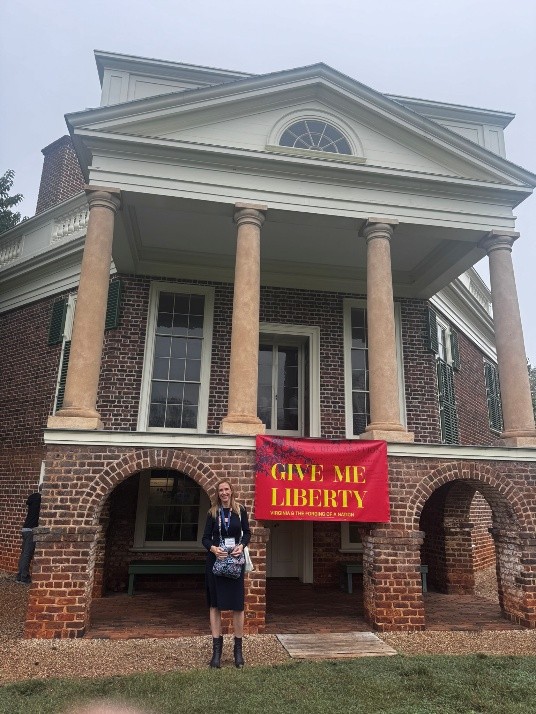
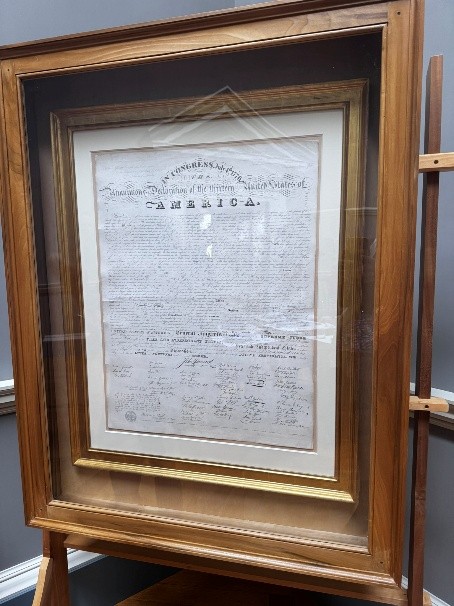
Jefferson began building this villa in Bedford County in 1806, during his second term as president, and used it as a private retreat after leaving public life in 1809. It is recognized as the first full-sized octagonal house in the United States, and Jefferson’s own correspondence makes clear that he considered it among his most personal architectural achievements. He traveled there two to four times a year, often staying for weeks at a time, accompanied by his enslaved servant Burwell Colbert and, in later years, by his granddaughters.
The house left the family in 1828 and passed through private owners for more than 150 years. A fire in 1845 burned the structure down to its brick walls, and the Hutter family rebuilt it as a far simpler Greek Revival farmhouse, replacing Jefferson’s balustrade and dormers, dividing his cubic central dining room into two stories, and removing portions of the service wing. Later owners modernized the house again in the mid-twentieth century. What survived, however, was the essential octagonal form, the original brick walls, and enough of the wing and its foundations to anchor a credible restoration once a nonprofit acquired the property in the 1980s.
Research Before Hands-On Work
What distinguishes the Poplar Forest restoration is its discipline. The Corporation committed to two governing principles: in-depth research precedes all physical work, and funding, mostly from private sources, is secured before any major phase begins. A Historic American Building Survey team documented the house in 1985 with measured drawings and photographs now held by the Library of Congress. Architectural historian S. Allen Chambers began combing hundreds of Jefferson’s letters and documents in 1986, and an Architectural Advisory Panel, professional staff and the consulting firm Mesick Cohen Waite, which was also working at Monticello and the University of Virginia, were assembled to oversee the work. Travis McDonald, hired in 1989 as Director of Architectural Restoration, has written that the board gave the professional team full control of the process without artificial deadlines, a freedom that most restoration projects never enjoy.
Before any restoration could begin, the house had to be stabilized. The team waterproofed the outer brick walls, underpinned them with concrete footings, and installed a dual drainage system that resolved moisture problems the house had suffered throughout its history. Only then did the physical investigation and phased restoration proceed.
Authentic Materials, Traditional Methods
From a sustainability and materials standpoint, the most instructive aspect of Poplar Forest is its insistence on period-appropriate materials and techniques. Between 1995 and 1998, crews conserved and restored brickwork using lime mortar and custom reproduction bricks, framed the flat “terras” roof over the central room with large timbers of antique old-growth pine, and built the surrounding rafters and joists in white oak using traditional heavy timber framing. That first phase earned an Honor Award from the National Trust for Historic Preservation.
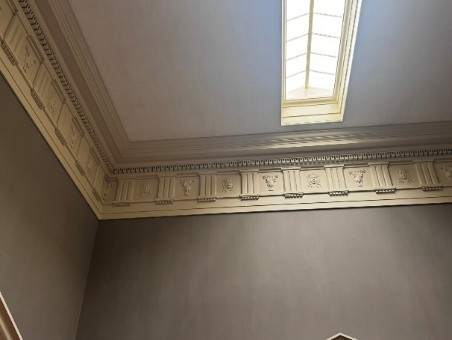
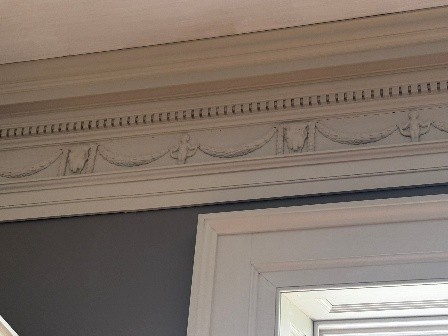
The second phase, from 1999 through 2009, installed new oak floor joists and floors, conserved and restored fourteen fireplaces and hearths, and applied traditional three-coat lime plaster under the direction of a craftsman from the Scottish Lime Centre. Crews conserved the two octagonal brick privies, roofing them with chestnut shingles, and reconstructed the 100-foot east service wing with its Jeffersonian terras roof deck, which Mr. McDonald describes as Jefferson’s only true architectural invention. Interior trim was hand-molded using antique tools and Jefferson-era poplar lumber from the site itself, and conservator Susan Buck analyzed hundreds of paint samples so that artisans Chris Mills and Erika Sanchez-Goodwillie could hand-make distemper, oil and lime wash finishes on site.
Modern performance was introduced only where it served longevity or safety and could be clearly distinguished from the historic fabric: a waterproof membrane beneath the roof shingles, stainless steel fasteners, and a minimal stainless steel cable railing on the wing deck that meets current code while remaining nearly invisible from a distance. The entire restoration was completed in 2023, roughly 34 years after it began.
The Craftsmen Behind the Masterpiece
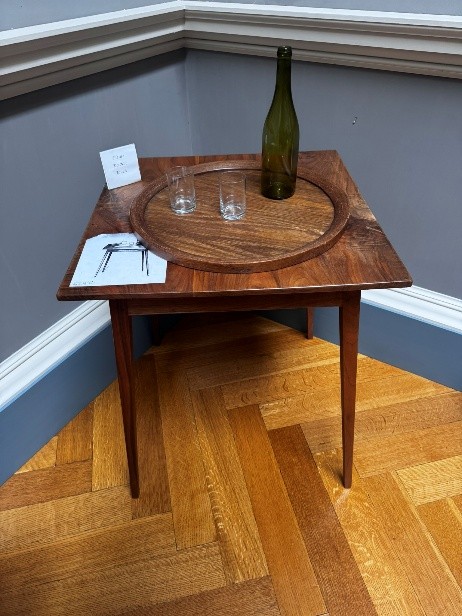
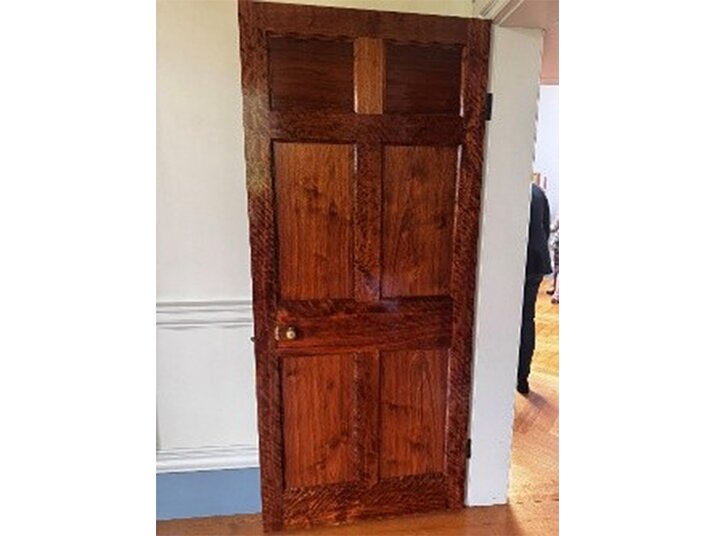
Poplar Forest is also one of the best-documented early American houses because of the letters exchanged between Jefferson and the workers he could not supervise in person. The most significant of these were written by John Hemings, an enslaved master joiner who ran the joinery shop at Monticello and worked independently at Poplar Forest from 1815 until Jefferson’s death in 1826. Hemings, who learned to read and write from Jefferson’s granddaughters, produced the house’s finished trim with three apprentices, his nephews Beverly, Madison and Eston Hemings, who were Jefferson’s sons by Sally Hemings. His written progress reports to Jefferson became essential evidence for the modern restoration team; the Chinese railing that now crowns the house, for example, was known only from a reference in one of his letters.
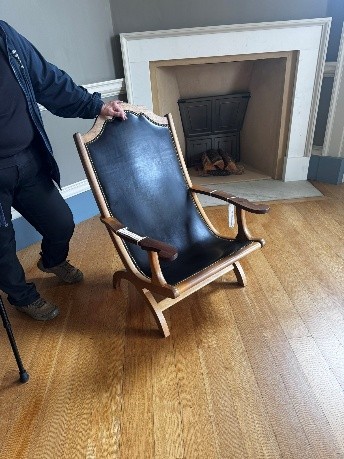
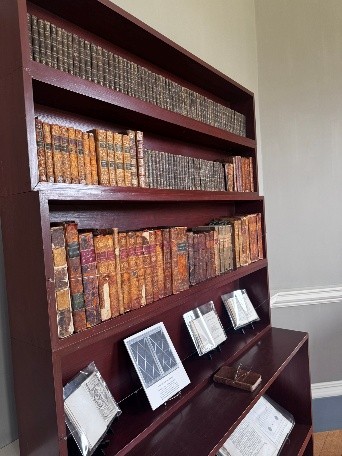
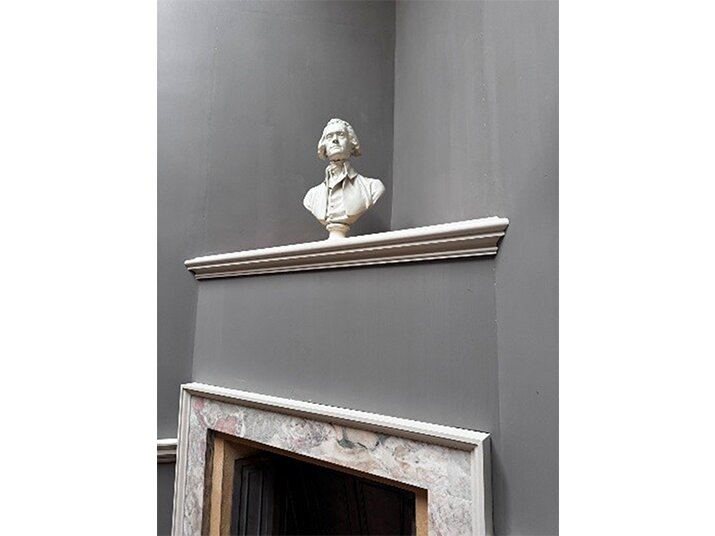
The restoration’s final phase deliberately followed the same sequence Hemings and his crew used, with restoration craftsmen working room by room with hand tools to reproduce the neoclassical moldings. One of the two surviving walnut doors Hemings made by hand is displayed in the house and served as the model for the replicas. Poplar Forest now interprets the stories of Jefferson’s family alongside those of the free and enslaved craftsmen who built the villa and the enslaved people who lived and labored on the plantation, which gives visitors a far more complete account of the site than the architecture alone could provide.
What Poplar Forest Teaches Us
For communities in the Fredericksburg region weighing what to do with their own historic assets, Poplar Forest offers three durable lessons. First, rigorous documentation and research protect both authenticity and budgets, because work done once and done correctly does not have to be redone. Second, private philanthropy can sustain a multi-decade effort when donors trust the governance and the professional team. Third, authentic materials matter, whether they are reproduction bricks laid in lime mortar or reclaimed old-growth timber, and the skilled trades that know how to work with them are an economic asset in their own right. These are the same principles that guide our salvage and reuse work at The Green Mission Inc., and they frame much of what I took away from the rest of the visit.
Sources
- 2026 Regional InterCity Visit Briefing Book, Fredericksburg Regional Chamber of Commerce
- Restoration & Reconstruction, Thomas Jefferson’s Poplar Forest
- Poplar Forest, Thomas Jefferson and John Hemings, The Washington Post (April 23, 2023)
- Jefferson’s Retirement Masterpiece: Restoring Poplar Forest, The Decorative Arts Trust
- History, The Virginian Hotel
- The Economic Impact of the Virginian Hotel, Lynchburg Economic Development Authority
- The Virginian: A History, Lynchburg Tourism
- Amazement Square Education Center, Architectural Partners
- $1 Million Gift to Amazement Square for Education Center, Downtown Lynchburg Association
- 2015 National Medal for Museum and Library Service, IMLS
- Construction milestone for Lynchburg’s $8M riverfront amphitheater, WSET
- Riverfront Park Amphitheater construction underway, WSLS
- Riverfront Park Amphitheater almost complete, WSLS
- Riverfront Amphitheater project materializing in Lynchburg, WSLS
- Construction has started to make improvements to Riverfront Park, WDBJ
- Lynchburg offers a look into the future of Riverfront Park, WDBJ
- Amphitheater announces official soft opening, News & Advance
- Jamerson-Lewis Construction company profile and projects, The Blue Book
- Patrick Henry Red Hill Education Center, The Blue Book
- Jamerson-Lewis Construction Charlottesville office, citybiz
- Aerofin
- Aerofin Case Studies
- Ampco-Pittsburgh business description, SEC filing
- HVAC Equipment Gets a Break as Section 232 Tariffs Are Revised, Contracting Business
- ADTRAN Holdings Form 10-Q, Q1 2026 (Section 232 restructuring)
- Helen of Troy Form 10-Q (Section 232 history)
- Watsco Form 10-Q, Q1 2026
- 2026 HVAC Price Increases by Brand, Paschal Air, Plumbing & Electric