


MARKET AND VALUATION ANALYSIS
Supply, demand, distribution channels, and a decade of valuation, current as of August 2026

Summary of findings
The reclaimed lumber trade is a large and growing global market, but antique barn lumber occupies a narrow, idiosyncratic corner of it. The material is genuinely scarce, genuinely finite, and priced with far less transparency than the commodity lumber it superficially resembles. For anyone valuing a barn, whether for sale, insurance, or a charitable contribution deduction, the central fact is that the secondary market is regional, thinly documented, and currently favors buyers.
- Values are nominally flat over the decade. Reclaimed barn siding sold for $5 to $10 per square foot at the 2016 peak of the farmhouse-chic cycle. In 2026 the published range is $5 to $8. Over the same period general consumer prices rose 39.1%, so in real terms the material has lost roughly a third of its value.
- The premium has migrated to structure, not surface. Hand-hewn timbers, large-dimension white oak, chestnut, and heart pine have held or gained value while common barn board has not. Hand-hewn material often calculates a 50% to 70% premium over sawn equivalents.
- The supply of historic barn structures is contracting, while demand remains concentrated in specific higher-value categories such as hand-hewn timbers, large-dimension hardwoods, flooring, and restoration-grade material. Agricultural census data shows 28% fewer working farms reported an old barn between 2007 and 2017, and fewer than one quarter of working farms now have a pre-1960 barn.
- Whether a barn owner gets paid or has to pay turns almost entirely on species, timber dimension, and access. A hand-hewn white oak frame may be purchased outright; a mid-century circle-sawn pole barn with limited salvage value may instead represent a net demolition cost of several thousand dollars.
- The valuation and tax environment tightened in 2026. The One Big Beautiful Bill Act introduced a 0.5% AGI floor on charitable deductions effective for tax years beginning after December 31, 2025, and two federal decisions have sharply increased the risk of cost-approach appraisals of deconstructed material.
What is actually in an antique barn?
A pre-1900 American barn is a different object from a mid-century agricultural building, and the distinction drives nearly every dollar of value in the secondary market. The older structures were framed from timber cut within a few miles of the site, from trees that had grown in unmanaged old-growth forest. That wood is denser, tighter-ringed, and larger in cross-section than anything a modern mill produces, because the trees it came from no longer exist at commercial scale.
Three attributes separate a valuable barn from a scrap pile. The first is species. White oak, American chestnut, and longleaf heart pine sit at the top; chestnut in particular is irreplaceable in practice, since the blight of the early twentieth century largely eliminated it as a major commercial timber resource. Reclaimed wormy chestnut trades at $18 to $20 per board foot at specialty dealers, and old-growth chestnut generally runs $8 to $15 or more per board foot. Common softwood pine from a twentieth-century barn may be worth $1 to $3.
The second is how the timber was worked. Authentic hand-hewn timbers retain the broadaxe and adze marks associated with historic fabrication, and they tend to generate the largest premium in the trade: 50% to 70% above sawn equivalents by one 2026 market analysis, 20% to 50% by another. Circle-sawn material, which appears after roughly 1860, is worth less; one Ohio dismantler states plainly that it will not buy circle-sawn barns unless the timbers are 10 by 10 inches or larger.
The third is dimension. Value per linear foot rises steeply with cross-section, because large old-growth timbers cannot be replaced from current forest inventory. A reclaimed 2×4 and a reclaimed 1×6 both sit in the $1.50 to $4.20 per linear foot band. A 2×8 runs $8 to $12. Sawn timbers in the 5×5 to 7×7 range run $14 to $18 per linear foot, and their hand-hewn equivalents $22 to $27. Antique oak 6×6 beams reach $25 to $30 per linear foot.
“Every building we take down, we deplete our livelihood.” (Mark Bowe, Barnwood Builders, speaking to NPR in 2016 about the finite nature of the resource.)
From standing barn to salable inventory
Deconstruction is not demolition. A barn taken down with an excavator yields firewood and landfill tonnage; a barn taken apart by hand yields graded inventory. The difference in labor is substantial: industry cost guides put careful deconstruction at roughly double the cost of mechanical demolition, and demolition itself runs $5 to $10 per square foot in the standard case and $7 to $12 for large or complex structures.
Recovery is far from complete. No rigorous barn-specific recovery study appears to exist in the public literature, which is itself worth noting for anyone tempted to assert a percentage. The closest available hard data comes from a USDA Forest Products Laboratory study of reclaimed hemlock remanufacture, which found that roughly 15% of original volume was lost in initial cut-to-length and defect removal and a further 51% in edging, surfacing, and resawing, leaving about a third of the starting volume as finished product. That study examined lumber remilling rather than whole-barn structural recovery, so it should be treated as a directional indicator rather than a barn statistic.
Processing is where most of the retail value is created, and this is the single most important thing to understand about barn lumber pricing. The same material can trade at a tenfold spread depending on how far it has been taken. One dealer lists reclaimed pine at $5 per board foot as-is and $10 to $15 per board foot de-nailed and kiln-dried. Another prices raw barn board siding at $0.65 to $3.27 per square foot while its milled flooring runs $6.98 to $12.02 per square foot. Published 2026 figures put as-is barn board at $1 to $5 per board foot against $4.35 to $8.00 for kiln-dried, de-nailed stock.
Appraisal implication: a value conclusion must state the condition and processing stage of the material being valued. Material donated as-is off the structure is not the same asset as the finished flooring a remiller eventually sells, and comparables must be drawn from the same stage of the chain.
Current market values by material type
The table below consolidates published 2026 secondary-market ranges. These are dealer and market ranges for material in good condition; they are not transaction-verified comparables and should not substitute for the documented comparable sales an appraisal requires.
Table 1. Reclaimed and antique barn material: published market ranges, 2026
Where antique barn materials can be purchased
The buy side is fragmented across six distinct channel types, and the price a buyer pays depends more on which channel they use than on the material itself. There is no central exchange, no published index, and no standardized grading system. Prices range from a dollar a board foot for a naily lot bought by the truckload to twenty dollars a board foot for graded chestnut at a specialty hardwood dealer.
Specialty dealers and remillers
These firms buy barns or barn material in bulk, process it, and sell finished or semi-finished product. They set the top of the retail market and are the most reliable source of published comparables. Pricing transparency varies sharply: some publish full price sheets while others quote only by telephone, which is a practical obstacle to comparable-sales research.
Nonprofit reuse warehouses
Numerous nonprofit reuse retailers operate donation-in, retail-out. They are important to the appraisal question because they are the typical donee organization in a deconstruction contribution, but their inventory is generally mixed construction salvage rather than curated antique barn lumber, and their pricing is deliberately accessible rather than market-clearing.
Online marketplaces and classified channels
BarnTraders.com is the closest thing the sector has to a dedicated national marketplace, listing standing frames, dismantled frames, and barn wood. Listings there illustrate the top of the market: a circa-1840s hand-hewn mixed-species frame measuring 40 by 54 feet was listed at $85,000 as a restored, ready-to-erect structure. Craigslist, Facebook Marketplace, eBay, and Etsy handle small-lot retail, largely to hobbyists. Contractor-to-contractor platforms such as OFFLOADIT and industrial reclaimers such as Repurposed Materials serve adjacent but distinct segments.
Architectural salvage yards, auctions, and direct purchase
Salvage yards carry barn material alongside doors, windows, and hardware, and are the natural channel for the non-lumber components of a barn. Farm and estate auctions occasionally include timber lots, but no dedicated live-auction channel for barn lumber could be verified; BarnTraders functions as a classified marketplace with asking prices rather than a bid venue. Direct purchase from the farm owner remains common and is how most dismantlers source inventory.
Table 2. Buy-side channels and observed price levels
Where antique barn materials can be sold
For a barn owner, the disposition question is rarely “how much is my barn worth” and almost always “which of four paths applies to me.” The paths differ enormously in proceeds, speed, and effort, and the right answer is determined by the barn, not by the owner’s preference.
The first path is selling the standing barn to a dismantler. This is the cleanest outcome when it is available. A dismantler who wants the frame will absorb the entire cost of taking it down and pay the owner besides. One Ohio operator states that it pays a deposit at contract signing and pays the owner in full before work begins, which is unusually favorable terms by the standards of most construction contracting. Against a typical barn teardown cost of roughly $8,000, that is a swing of five figures.
But the offer is conditional. The same operator will not buy circle-sawn barns unless timbers are 10 by 10 inches or larger, and offers site cleanup only when the lumber carries enough value to fund it. Another dismantler distinguishes explicitly between paid purchase for antique barns with substantial quality wood and free removal for everything else, where the wood itself is the consideration. A third maintains separate intake paths: a purchase program for wood already dismantled, de-nailed, and dried, and a free-removal program for standing structures.
The second path is wholesale sale of already-salvaged material to a dealer. This is slower and requires the owner to have absorbed the deconstruction cost, but it captures more of the value chain. Scale matters: one national remiller will not purchase below a 4,000 board foot minimum. The third path, direct retail sale, is theoretically the highest-value route and practically the slowest: one forum contributor with substantial inventory reported selling roughly $100 worth over an extended period.
The fourth path is charitable donation to a nonprofit reuse organization, which converts material value into a tax deduction rather than cash. In our appraisal practice, deconstruction contributions can involve material values well above the $5,000 qualified-appraisal threshold and, in larger projects, may exceed $500,000. This is the path that requires the most rigorous documentation, and it is treated separately below.
Table 3. Disposition paths for a barn owner
Ancillary costs that apply regardless of path: debris disposal $400 – $3,000; asbestos inspection $200 – $600; abatement $2,000 – $10,000; foundation removal $1,000 – $5,000. Full demolition runs $1,500 – $4,000 for barns under 500 SF and $10,000 – $25,000+ above 1,500 SF.
Market demand: who buys, and why
Demand for reclaimed barn material comes from four distinguishable buyer groups, and their relative weight has shifted materially over the past decade.
Commercial interiors are the largest and least price-sensitive. Restaurants, breweries, hotels, and retail build-outs account for the bulk of the market (commercial users hold roughly 63% of market share), and hospitality and retail projects will reportedly pay eight to ten times the cost of virgin lumber for material with documented provenance. For these buyers the wood is a design asset, and its price is a rounding error against the fit-out budget.
Residential renovation is the volume segment and the one that drove the 2015 to 2018 boom. It is also the most fashion-sensitive: the accent wall that defined the farmhouse-chic era is a discretionary purchase, and it responds immediately to interest rates and consumer confidence.
Flooring is the largest application by revenue at roughly 38% and the fastest-growing hardwood category. Heritage and historic restoration is the fastest-growing segment overall at about 4.7% annually, and it is structurally different from the others because it is a genuine substitution market: a restoration architect matching 1830s framing has no alternative to reclaimed stock.
Three durable forces support demand independent of design fashion. Construction material prices rose 6.2% in 2025, the largest annual increase since 2021, which narrows the gap between reclaimed and new. Lifecycle-carbon disclosure requirements and LEED v5 credits reward reused material directly. And circular-economy regulation in a growing number of jurisdictions diverts demolition debris from landfill, with deconstruction ordinances in cities such as Portland creating both mandated supply and an institutional market.
Supply: a resource in visible decline
The defining structural feature of this market is that the inventory is fixed and shrinking. No one is building new hand-hewn barns.
The Census of Agriculture provides the only systematic national measurement. Between 2007 and 2017, the number of working farms reporting an old barn on the property fell 28%. State-level declines ranged from 10% to 45%, averaging 27%. Fewer than one quarter of America’s working farms (a mean of 23%) now contain a pre-1960 barn, and in some states the figure is below 10%. The census understates the total stock, since it excludes barns on properties no longer classified as working farms and counts a farm with several historic barns once, but the direction and rate of change are unambiguous.
Old-growth demolition inventory is reported to be dwindling particularly in the Eastern United States, precisely where the oldest and most valuable timber frames stand. Meanwhile the labor-intensive de-nailing and remilling required to bring material to market limits how quickly supply can respond to price. Deconstruction ecosystems are strongest in the Pacific Northwest, where policy support is greatest, which is not where most antique barns are.
Freight economics reinforce the regionalization. A quote of nearly $7,000 to move 1,000 board feet of white oak from Chicago to Phoenix was dismissed as commercially unreasonable by experienced shippers, and the practical conclusion drawn in the trade is that only premium or rare material can bear long-distance freight. Established dealers source regionally as a result: one major New England remiller sources primarily in New England and New York, extending west only to Pennsylvania and Ohio and south to West Virginia. Barn lumber is therefore not one national market but a set of regional ones with materially different clearing prices.
A decade of valuation, 2016 to 2026
The past ten years divide into three distinct phases, and conflating them is the most common error in barn lumber valuation.
Phase one: the farmhouse-chic peak, roughly 2014 to 2018
Fixer Upper premiered in 2013 and Barnwood Builders in 2014, and the effect on demand was immediate and well documented. By September 2016, reclaimed wood was selling at $5 to $10 per square foot, dismantlers were paying up to $1,000 for a barn, and deconstruction was running about $500 a day per project. Contemporaneous reporting described barns being sourced aggressively across Kentucky and the Midwest to feed the trend, and noted that farmers who had regarded their barns as liabilities were beginning to recognize “the capital they’re sitting on.” The appeal was explicitly national, reaching, as NPR put it, from Manhattan to Manhattan Beach.
Phase two: the commodity shock, 2020 to 2022
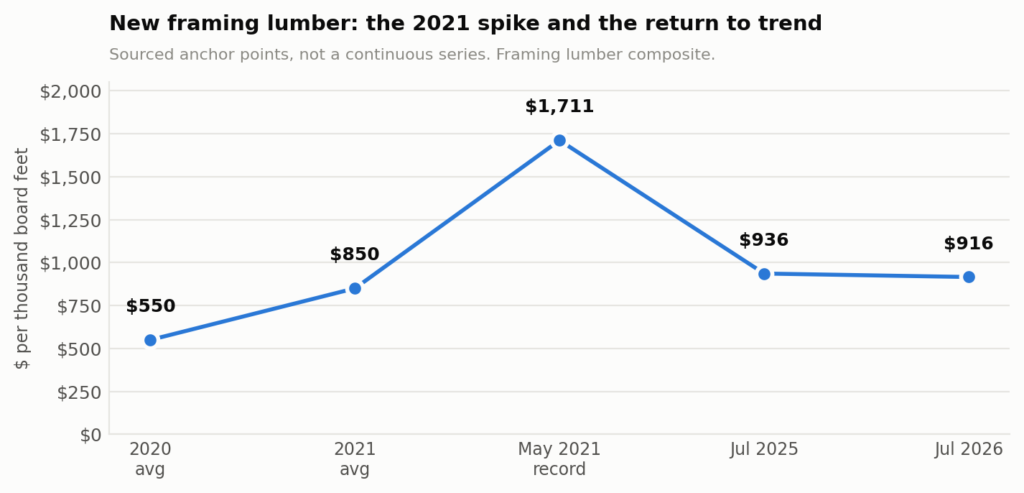
The pandemic-era lumber spike distorted every reference point in the market. The framing lumber composite averaged roughly $550 per thousand board feet in 2020 and nearly $850 in 2021, having risen 162% between the fourth quarter of 2019 and April 2021, with a record $1,711.20 set in May 2021. Real prices across the 2020 to 2021 span ran 37% above the historical average.
This mattered to the reclaimed market in a specific and often misunderstood way. Reclaimed material is priced against new lumber as a substitute at the margin, so the spike compressed the apparent premium and pulled some buyers toward salvage. But the spike was a new-lumber phenomenon driven by mill capacity and freight, and it did not durably reset reclaimed values. Appraisals that anchored to 2021 comparables are anchored to an artifact.
Phase three: normalization and softening, 2023 to 2026
New lumber settled well below the peak. The framing composite stood at $936.05 per thousand board feet in July 2025 and $915.88 in July 2026, a 2.15% year-over-year decline. Futures tell a weaker story still: $568 per thousand board feet as of August 14, 2026, down 9.8% month over month and 6.8% year over year, with tariff uncertainty and soft single-family construction cited as the drivers and a forecast of $561.87 by the end of the third quarter.
Reclaimed barn values did not track the new-lumber recovery. The clearest available comparison is barn siding, the volume product. Finished, retail-grade weathered siding sold at $5 to $10 per square foot in 2016 and the same product category is published at $5 to $8 in 2026; both figures reflect the retail siding series rather than raw stock. The floor held; the ceiling came down 20%. Against cumulative consumer inflation of 39.1% over the same ten years, flat nominal pricing represents a real decline of roughly 28%.
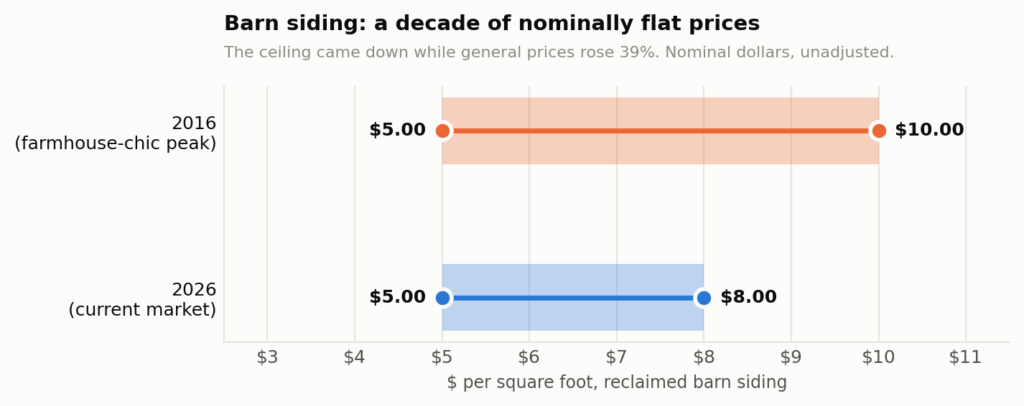
Table 4. Decade reference points
The current market, August 2026
The market has bifurcated. Common barn board and dimensional stock have softened, while hand-hewn timber, large-section oak, chestnut, and heart pine have held. The premium has migrated from the aesthetic surface of the material to its structural rarity. A barn’s value in 2026 depends far more on its frame than on its siding, a reversal of the 2016 pattern, when weathered board face was the product and the timbers were often an afterthought.
It rewards processing more than ever. With as-is material soft and finished product firm, the spread between the two is where the margin now sits. For an owner, this means the gap between selling a barn as-is and selling processed inventory has widened, though capturing it requires capital, storage, and time that most owners do not have.
And it remains stubbornly opaque. Several significant dealers publish no pricing at all, quoting only by telephone. There is no auction record, no index, and no standard grade. For an appraiser this is not a minor inconvenience; it is the central methodological problem, because a supportable sales comparison approach depends on comparable-sales evidence that the market does not readily disclose.
Valuation, appraisal standards, and the 2026 tax environment
Where a barn is donated rather than sold, the valuation question becomes a tax question, and the standards are demanding. Two federal decisions define the current landscape and both resulted in complete disallowance of the deduction.
In Mann v. United States, decided at the district court level in 2019 and affirmed by the Fourth Circuit in January 2021, a claimed $313,353 deduction was disallowed. The appraisal at issue used an R.S. Means replacement-cost methodology, applied a 17% depreciation factor, and valued the structure’s building components without adequately distinguishing among materials that would actually be recovered and donated, materials destroyed during deconstruction, and materials remaining on site. The decision illustrates the substantial risk of applying a replacement-cost-less-depreciation methodology to deconstruction materials without adequately connecting the valuation to the specific property actually contributed. In Loube v. Commissioner, T.C. Memo 2020-3, the deduction failed on Form 8283 deficiencies alone, independent of the underlying valuation.
The practical requirements follow directly from those holdings.
- Where an active secondary market exists for the donated materials, the sales comparison approach generally provides the most directly supportable measure of fair market value. Fair market value means a willing buyer and a willing seller, neither under compulsion, both reasonably informed, in the market in which the property is most commonly sold to the public. Mann demonstrates the substantial risk of relying on replacement-cost estimates and unsupported depreciation assumptions where the appraisal does not correspond to the property actually recovered and donated. Reliance on construction-cost estimating systems such as R.S. Means or Marshall & Swift as the primary basis for fair market value can present substantial valuation risk where an observable secondary market exists, particularly if the methodology values components that were not actually recovered and donated or applies unsupported depreciation assumptions.
- For deconstruction appraisals, a defensible appraisal should be built from an itemized inventory of the property actually recovered and contributed, supported where practicable by photographs, measurements, condition information, and relevant market evidence. The qualified appraisal regulations require the property to be described with sufficient specificity to identify the contributed property and require disclosure of the valuation method and the specific basis for the value conclusion. Broad aggregation without sufficient identification of the property actually donated creates significant substantiation and valuation risk.
- The appraisal must be performed by a “qualified appraiser” within the meaning of IRC §170(f)(11) and Treas. Reg. §1.170A-17. A qualified appraiser generally must either hold a recognized appraisal designation from a generally recognized professional appraisal organization or satisfy the applicable education requirements and have at least two years of experience valuing the type of property being appraised. The appraiser must also regularly perform appraisals for compensation and meet the other regulatory requirements and exclusions.
- Timing is strict. A qualified appraisal must be signed and dated no earlier than 60 days before the contribution date and no later than the due date, including extensions, of the return on which the deduction is first claimed. The valuation effective date must separately comply with Treas. Reg. §1.170A-17, generally using the contribution date when the appraisal is completed on or after the contribution.
- Subject to the statutory exceptions, Form 8283 Section B is required for noncash donations over $5,000, with the donor completing Part I, the appraiser signing Part IV, and the donee signing Part V. For deductions exceeding $500,000 for an item or group of similar items, the full qualified appraisal must be attached to the return.
Two changes took effect for tax years beginning after December 31, 2025 under the One Big Beautiful Bill Act, and both can reduce the after-tax benefit of a deconstruction donation. A 0.5% AGI floor now applies to charitable contributions, so a donor with $400,000 of adjusted gross income loses the first $2,000 of deduction value. Separately, taxpayers in the top 37% bracket face a new limitation on the tax benefit of certain itemized deductions, computed under a 2/37 reduction mechanism that effectively caps the rate benefit of affected deductions at 35%; it is not a flat percentage reduction of deductions measured against income above a threshold. The applicable AGI percentage limitation on any given contribution continues to depend on the type of property, the holding period, the donee organization, and whether fair market value or basis governs the deduction under IRC §170(b) and §170(e). Concentrating or “bunching” charitable contributions into selected tax years may reduce the effect of repeatedly applying the annual 0.5% floor.
This section describes general requirements and is not tax advice. Application depends on the taxpayer’s circumstances and should be confirmed with the practitioner handling the return.
Practical implications
For a barn owner, the first question is not what the barn is worth but what it is framed with. A hand-hewn white oak or chestnut frame containing large-dimension timbers may be sufficiently desirable for a specialist dismantler to purchase the structure and absorb some or all of the removal cost. A mid-century circle-sawn pole barn with limited salvage value may instead represent a net demolition cost, with published demolition estimates commonly running into several thousand dollars, and no amount of market research will convert it into a windfall. Establishing which one is standing on the property costs nothing and determines everything that follows.
For an appraiser, the current market punishes three specific habits: anchoring to 2021 comparables, applying cost-approach logic to material with an active secondary market, and using midpoint or top-of-range values without documenting why. Published 2026 ranges are wide (the 2×6 band spans $4.00 to $7.20, a spread of 80%), and where in that band a particular lot falls is a matter of species, condition, dimension, and region that the appraisal must actually address rather than assume.
For anyone building or maintaining a valuation model, the softening at the surface and the firmness in the structure argue for separating the two. A single blended rate per square foot of barn will systematically overvalue common siding and undervalue a hand-hewn frame. Given that the frame is where the scarcity premium now sits, and that available agricultural census data documented a substantial decline in historic barn inventory over the measured 2007 to 2017 period, that is the error most likely to matter.
Sources
- The Green Mission Inc. – The Lumber Market in 2026
- The Green Mission Inc. – The Secondary Market for Reclaimed Building Materials
- The Green Mission Inc. – Producing Deconstruction Appraisals That Hold Up Under IRS Review
- NPR – Your Dilapidated Barn Is Super Trendy. Just Ask HGTV
- National Barn Alliance
- NAHB / Eye on Housing
- Trading Economics – Lumber Futures
- USDA Forest Products Laboratory
- Colonial Barn – Reclaimed Lumber Price Sheet
- Appalachian Woods LLC
- Wood Vendors – Reclaimed Lumber
- Hearne Hardwoods
- 18th & 19th Century Recycling
- Vermont Salvage – Barn Board
- Timeless Lumber
- Ohio Valley Barn Salvage
- Antique Building Solutions
- Creekside Barn Company
- Pioneer Millworks – Sell Us Your Wood
- Longleaf Lumber
- BarnTraders.com
- Reclaimed Lumber Products
- OldBarnsForSale.net – Reclaimed Barn Wood Value Guide
- Design Transition Studio – Old Barn Wood Prices
- Hometown Demolition
- Dropcurb
- WoodWeb – Tips for Shipping and Selling Lumber Nationwide
- IRS – Instructions for Form 8283
Prepared August 17, 2026. Market ranges reflect published secondary-market data and dealer price sheets current as of that date; they are not transaction-verified comparables. Where a figure could not be verified against a primary source, that limitation is stated in the text. Nothing in this document constitutes tax, legal, or investment advice.